As an Amazon Associate & Influencer, we earn from qualifying purchases you might make if you click any of the links or buttons on this page at no expense to you.
My first choice for a conventional single-DIN upgrade is the Kenwood Excelon KMM-X705. Its separate front, rear and subwoofer preamp outputs give you room to build a proper system, and its short chassis is useful in a crowded dash. For a straightforward Bluetooth upgrade on a tighter budget, I would buy the JVC KD-X280BT. If you still play CDs, the Kenwood Excelon KDC-X705 keeps the disc slot without making you give up the useful audio controls.
Start with the type of upgrade you want. These five picks are traditional single-DIN radios with physical controls. They do not display CarPlay maps, Android Auto or a backup camera. A single-DIN touchscreen is a different purchase: the radio chassis may fit while its floating or flip-out screen blocks dashboard controls.
Quick picks: three ways to choose
Best overall
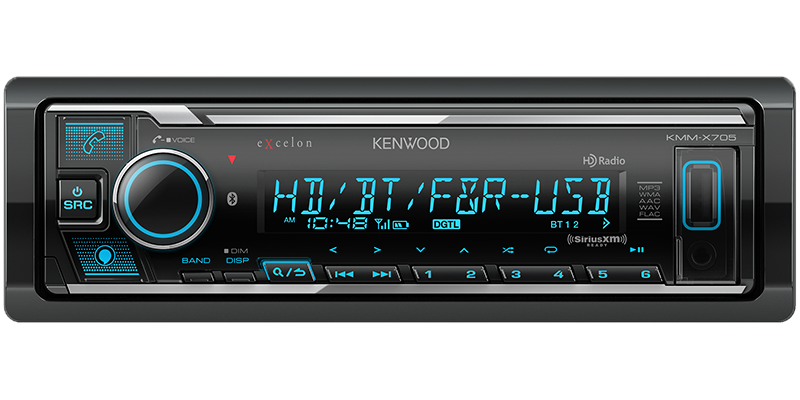
Kenwood Excelon KMM-X705
Three pairs of 5V preouts and detailed tuning make it my pick for a system you can improve in stages.
Skip it if: you need a CD slot, on-screen maps or a camera display.
Best value
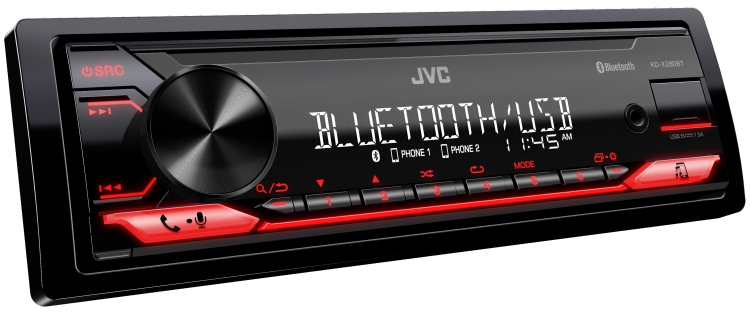
JVC KD-X280BT
A short chassis, Bluetooth calls and 13-band EQ cover the useful basics without paying for a bigger system.
Skip it if: you need separate front, rear and subwoofer RCA outputs.
Best for CDs
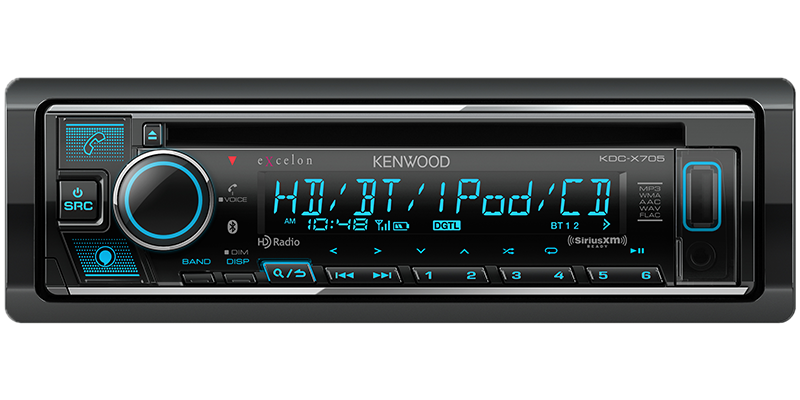
Kenwood Excelon KDC-X705
Keeps CD playback and the three separate 5V amplifier outputs that make the mechless Kenwood appealing.
Skip it if: your dashboard cannot accommodate its deeper body and rear connections.
Compare the best single-DIN car stereos
| Stereo / best use | Why I would choose it | Main limitation | Current price |
|---|---|---|---|
| Kenwood Excelon KMM-X705 Best for an expandable system | Front/rear/sub 5V preouts; 13-band EQ and time alignment | No CD or CarPlay; rear wiring still needs clearance | Check Current Price on Amazon |
| JVC KD-X280BT Best value for Bluetooth | 13-band EQ and time alignment in a compact receiver | One 2.5V RCA pair, selectable rear or subwoofer | Check Current Price on Amazon |
| Kenwood Excelon KDC-X705 Best with a CD player | CD playback plus front/rear/sub 5V preouts | 155.5mm installation depth before wiring clearance | Check Current Price on Amazon |
| Alpine UTE-73BT Best for a simpler setup | Three preamp pairs and a simpler tuning menu | 2V preouts; less detailed tuning than the Kenwoods | Check Current Price on Amazon |
| Pioneer MVH-S322BT Best for Smart Sync users | Bluetooth, USB and Pioneer Smart Sync support | Phone app is not CarPlay; two preamp pairs | Check Current Price on Amazon |
Jump to: Choose by your setup · Close comparisons · Extra parts · Before you order · FAQs
Choose by the system you want to build
| Your plan | My choice | Why it makes sense |
|---|---|---|
| Replace an old radio; keep four suitable speakers | JVC KD-X280BT | Useful Bluetooth and tuning without paying for three unused RCA pairs. |
| Add a four-channel amplifier and a subwoofer | Kenwood KMM-X705 | Separate front, rear and subwoofer outputs preserve independent control. |
| Keep playing CDs | Kenwood KDC-X705 | A disc slot with the same useful type of amplifier expansion. |
| Make a few adjustments, then leave it alone | Alpine UTE-73BT | Simpler tuning with three separate output pairs. |
| Use a phone app for receiver controls | Pioneer MVH-S322BT | Smart Sync is its meaningful differentiator. |
| Put maps or a camera image on the dashboard | A suitable touchscreen receiver | None of the five radios above provides a visual CarPlay or camera interface. |
I would decide on the future signal path before comparing EQ presets or illumination colors. A radio that has the outputs you need is worth more than one with extra cosmetic features. Equally, there is little point paying for a multi-amplifier foundation when the vehicle will always use four speakers on radio power.
1. Kenwood Excelon KMM-X705 — Best for an expandable system
Choose it if: you want Bluetooth now and independent amplifier connections for front, rear and bass later.
Skip it if: you need a CD slot, on-screen maps or a camera display.
The KMM-X705 is the single DIN stereo I would build around when the plan extends beyond replacing a broken radio. The important advantage is its output layout. You can feed a speaker amplifier and a subwoofer amplifier separately, keep the front/rear balance, and adjust bass without treating the whole system as one signal.
At a glance
- Format: mechless single-DIN receiver; Bluetooth, HD Radio and front/rear USB.
- Amplifier connections: three pairs of 5V preamp outputs for front, rear and subwoofer.
- Sound controls: 13-band EQ, digital time alignment and crossovers.
- Installation size: 182 × 53 × 100mm; 22W × 4 full-bandwidth power at less than 1% THD, for 4–8Ω speakers.
I would pay for those separate outputs before paying for an elaborate display that only shows track names. They solve a practical problem: a later amplifier upgrade can use the radio’s intended outputs rather than another conversion box or a compromise in channel control.
Why it earns the top spot
Time alignment is useful when the driver sits much closer to one speaker than the other. It lets you delay the nearer channels so their arrival times can be brought closer together. The 13-band EQ gives finer adjustment than a simple bass/treble menu, while the crossover can keep deep bass away from small speakers. None of these settings improves the system automatically; they are tools for a careful setup.
The shallow chassis is another reason to choose it over the CD-equipped KDC-X705. Removing the disc mechanism leaves more room for the vehicle harness and RCA connectors. That matters in an older dashboard with ducting behind the radio. It also makes more sense if nearly all your listening is Bluetooth or USB.
When I would spend less
If you will keep four speakers running directly from the radio and never add an amplifier, the JVC KD-X280BT already covers the essentials and provides substantial tuning. The Kenwood becomes the stronger purchase when HD Radio, dual USB or separate amplifier channels are features you will actually use.
A 5V preout does not put five volts of extra power into your speakers. It is a line-level connection to an amplifier. Match the amplifier’s input range and set its gain correctly; buying the higher-voltage radio is not permission to turn every gain control up.
Fit and setup
Allow space behind the 100mm installation depth for the plugs and cable bends. Use a dash kit and vehicle harness or integration interface chosen for the exact factory system. Mount the supplied call microphone in a suitable position and route its cable away from moving parts and airbag deployment paths.
The small text display suits music and calls, but it is a poor substitute for a navigation screen. SiriusXM capability also requires the appropriate separate tuner and service. I would not make legacy phone-app integrations the reason to buy this radio; the core audio connections are the lasting benefit.
Kenwood specifications and connections · Owner’s manual
My verdict: The strongest all-round choice here for an owner who wants a clean dash and a radio that can remain in place through later audio upgrades.
2. JVC KD-X280BT — Best value for Bluetooth
Choose it if: you want calls, music streaming and useful tuning while keeping the radio in charge of your speakers.
Skip it if: you need separate front, rear and subwoofer RCA outputs.
The KD-X280BT is my value pick because it saves money in a sensible place. You still get Bluetooth calling with an external microphone, USB playback, a physical volume knob and more tuning than a bare-bones replacement radio. The main compromise is amplifier expansion, which is easy to overlook when comparing front-panel features.
At a glance
- Format: single-DIN digital media receiver; Bluetooth, front USB and front AUX; no CD.
- Outputs: one 2.5V RCA pair, switchable between rear and subwoofer duty.
- Tuning: 13-band EQ, digital time alignment, high-pass and low-pass filters.
- Fit and power: 182 × 53 × 100mm installation size; 22W × 4 full-bandwidth output at less than 1% THD, for 4–8Ω speakers.
I would choose this over an unbranded radio with a long feature list. Its combination of short chassis and useful audio controls addresses the actual job: making an older car work with your phone while keeping installation manageable.
A good match for radio-powered speakers
For a daily driver with four suitable speakers, the single RCA pair may never be a limitation. You can run the cabin speakers from the radio and use that pair in subwoofer mode if you later add a powered bass unit. That is a practical upgrade path for a modest system.
The limitation appears when you want a separate four-channel amplifier plus independently controlled bass. You do not get three discrete RCA pairs. If that upgrade is already on your list, buy the KMM-X705 now rather than saving on the receiver and paying for additional signal-routing compromises later.
The small-screen tradeoff
The white text and red keys keep the interface simple, but illumination flexibility is narrower than the variable-color Kenwoods. That matters if you want the radio to blend with an amber, green or white factory dashboard. Decide whether matching the dash is worth the additional cost before paying for it.
Two phones can remain connected for calls, but Bluetooth music playback still comes from one source at a time. Shared-phone capability is convenient; it does not turn the radio into a mixer or provide CarPlay.
Fit and setup
The short body does not eliminate the need for a correct mounting kit. Confirm depth, the connector path and any factory amplifier before ordering. The included wired microphone is part of the installation, not an optional extra to leave in the box if calls matter to you.
I would skip the JVC for a planned multi-amplifier build. For Bluetooth, USB and a single powered subwoofer, however, its simpler outputs are an acceptable compromise. Put the savings into the right harness and an installation that preserves the functions you use.
JVC specifications and support · Owner’s manual
My verdict: My first choice for a basic Bluetooth upgrade, provided one switchable RCA pair is enough for your future plans.
3. Kenwood Excelon KDC-X705 — Best with a CD player
Choose it if: your CD collection still gets regular use and you also want Bluetooth and amplifier expansion.
Skip it if: your dashboard cannot accommodate its deeper body and rear connections.
The KDC-X705 is the right answer for someone who still uses CDs and refuses to buy an otherwise limited radio just to keep a disc slot. It retains the same useful kind of system control as the KMM-X705: three separate preamp pairs, detailed EQ and time alignment. The deciding factor is physical depth.
At a glance
- Sources: CD, Bluetooth, USB, AUX and built-in HD Radio.
- Expansion: three 5V preamp output pairs for front, rear and subwoofer.
- Audio controls: 13-band EQ, digital time alignment and crossovers.
- Installation: 182 × 53 × 155.5mm; 22W × 4 full-bandwidth output at less than 1% THD, for 4–8Ω speakers.
I would choose it over a simpler CD receiver when a subwoofer or speaker amplifier is part of the plan. Keeping physical media should not force you to give up independent control of the rest of your system.
Who should keep the disc slot
A CD receiver is worth buying when discs are a real listening source: an existing collection, a vehicle without a reliable mobile-data routine, or several drivers who prefer physical media. The CD player works independently of a phone’s battery or wireless pairing. That is a concrete benefit, not a reason to insist that CDs always sound better than every digital source.
If you only want the slot for the occasional disc you might play someday, I would take the shorter KMM-X705. A CD mechanism occupies valuable dashboard space. The KDC body is 55.5mm deeper by Kenwood’s installation dimensions, before either radio’s plugs are counted.
Why the audio section matters
Three preamp pairs let you add amplification without collapsing front, rear and bass into one shared output. The EQ and crossovers also give you useful control while running suitable speakers directly from the receiver. You can improve the system in stages instead of replacing the head unit again.
Do not buy it expecting visual smartphone integration. Its USB and Bluetooth functions handle media and calls; they do not put Google Maps on the radio. For screen-based navigation, choose a suitable touchscreen receiver and check the screen’s clearance separately.
Fit and setup
Measure the available cavity rather than assuming that a factory CD player proves this receiver will fit. The aftermarket harness, retained-function interface and RCA plugs may occupy space differently. Leave enough room for a natural cable bend and a secure mounting arrangement.
You pay in money and dashboard space for a source you may rarely use. That is a worthwhile trade for a CD listener and a poor one for a phone-only listener. Add a compatible SiriusXM tuner and subscription only if satellite radio is part of your plan.
Kenwood KDC-X705 specifications · Owner’s manual
My verdict: The pick for regular CD listeners who want a serious upgrade path. Choose the KMM-X705 instead if the disc slot is merely a backup idea.
4. Alpine UTE-73BT — Best for a simpler setup
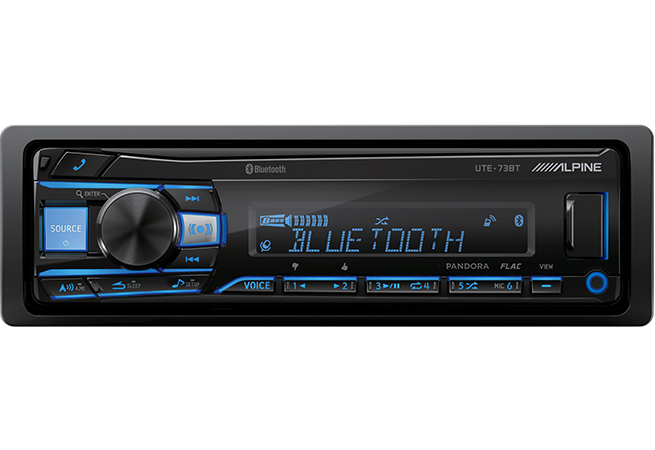
Choose it if: you want Bluetooth and independent amp connections without a long list of fine tuning menus.
Skip it if: you want digital time alignment or more precise 13-band EQ adjustment.
The UTE-73BT is my choice for someone who wants the system to remain straightforward. Bluetooth, front USB and AUX cover everyday listening, while three RCA pairs keep amplifier expansion practical. Its three-band parametric EQ gives you a simpler set of adjustments than the 13-band systems on the Kenwood and JVC.
At a glance
- Format: mechless single-DIN AM/FM receiver with Bluetooth, front USB and AUX.
- Outputs: three pairs of 2V preamp outputs.
- Tuning: three-band parametric EQ and high-pass/low-pass crossovers.
- Amplifier: 18W × 4 at the CTA-2006 rating; 50W × 4 is the maximum figure.
I would buy it for a modest system with clearly defined needs, especially when you want separate amplifier connections but do not want to spend time navigating an extensive tuning interface. Simpler controls can be a useful preference rather than an audio disadvantage.
Three bands are enough for some owners
A parametric EQ lets you work on a selected frequency region rather than treating the entire bass or treble range as one adjustment. It is useful for broad corrections. It is less flexible than having many independently adjustable bands when you are trying to address several specific problems across the cabin.
That distinction is why I prefer the KMM-X705 for an owner who enjoys tuning. The Alpine is better suited to setting sensible crossover points, making a few broad tonal adjustments and leaving the system alone. I would not pay more for it solely because of the badge if the Kenwood’s extra control would actually be useful.
A practical step above a one-pair radio
The three RCA pairs are the feature I would protect when comparing it with the JVC. They let you keep front, rear and bass on separate signal paths. The 2V rating is lower than the Kenwood’s 5V, but a correctly matched amplifier can work with it. Higher preout voltage alone does not establish that one completed system will sound better.
Front USB and AUX are convenient for temporary connections. They also leave cables visible across the front panel. If a tucked-away USB lead is a priority, the KMM-X705’s rear USB is the more useful layout.
Fit and setup
Check the actual radio dimensions and harness space against the dash kit’s application information. A vehicle-specific harness is separate from the receiver’s own wiring harness. Keeping factory steering-wheel controls may require a compatible interface, even though the Alpine is ready to work with steering-wheel remote equipment.
There is no CD drive or on-screen smartphone navigation. The simpler EQ also gives you less scope for fine corrections than the other receivers here. I would choose it deliberately for simplicity, rather than call it the best choice for every audio enthusiast.
Alpine UTE-73BT specifications and manual
My verdict: A sensible radio for an uncomplicated upgrade with separate amplifier connections. For more detailed tuning and dual USB, I prefer the KMM-X705.
5. Pioneer MVH-S322BT — Best for Smart Sync users
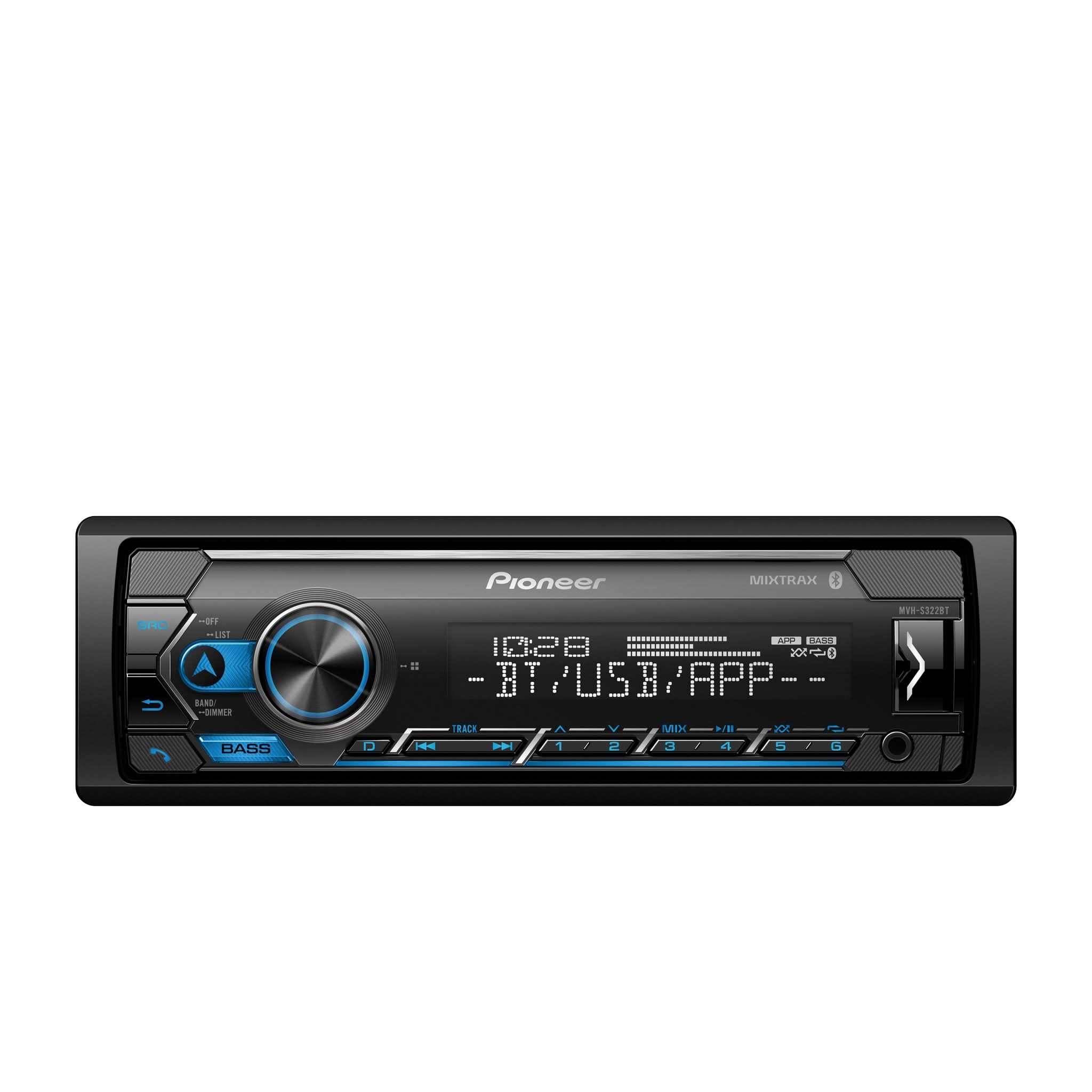
Choose it if: you prefer adjusting supported radio functions through Pioneer Smart Sync on your phone.
Skip it if: you want CarPlay or three fully independent RCA output pairs.
The MVH-S322BT suits an owner who likes the idea of a familiar single-DIN radio with phone-assisted control. Pioneer Smart Sync is the reason I would choose it over the JVC or Alpine. It gives you another way to work with supported receiver functions while the dashboard keeps its physical controls.
At a glance
- Format: mechless single-DIN Bluetooth receiver with USB and AUX.
- Phone integration: Pioneer Smart Sync compatibility; no Apple CarPlay or Android Auto display.
- Tuning: 13-band EQ on the receiver; expanded EQ functions through Smart Sync.
- Expansion: two RCA preamp pairs; check the front/rear/sub selection for your amplifier layout.
I would buy it when the app is a feature you want to use. If your intention is simply to pair a phone and leave the settings alone, the JVC is the more direct value choice. For separate front, rear and subwoofer amplification, the Kenwood is the cleaner starting point.
Smart Sync changes the control method
An app can make supported adjustments easier to see on the phone’s larger display. That is useful when a tiny radio display makes a menu awkward. It still means managing a phone, its mount and its app compatibility. Set up the receiver while parked rather than turning sound adjustment into another task during a drive.
Smart Sync does not give this radio a touchscreen. Your maps remain on the phone, and you do not get the CarPlay or Android Auto interface on the receiver. That distinction matters more than the advertised number of app-assisted EQ bands.
Where I would draw the line
Two preamp pairs can serve a simple amplified system, but they are not the same as separate front, rear and subwoofer pairs. Work through the available output modes before planning the amplifier connections. If independent front/rear fading and bass adjustment are requirements, buy a receiver designed to supply all three.
I would also avoid choosing it on a large maximum-power headline. The receiver’s job is media, controls and a suitable signal path. If your speakers need materially more clean output than a conventional radio can deliver, budget for an external amplifier instead of chasing a larger number on the box.
Fit and setup
Confirm the mounting depth, kit and harness for your vehicle. Use a compatible microphone position for calls, and choose a secure phone mount if Smart Sync will be part of everyday use. Check that your current phone and operating system support the app before making it the deciding feature.
The app adds another part to the user experience. That is appealing to an owner who wants it and unnecessary for an owner who wants the radio to be self-contained. It is also a less convenient base for a three-output amplifier build than either Excelon receiver.
Pioneer MVH-S322BT features and connections
My verdict: A good fit for a Smart Sync user. My broader recommendations remain the JVC for a simple upgrade and the KMM-X705 for system expansion.
What else you need
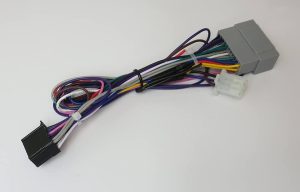
Budget for the complete installation. The receiver’s supplied harness connects to the receiver; it does not automatically mate with the car. The correct parts depend on the exact year, trim, factory radio and premium-audio package.
| Item | When it is needed | Included or separate? |
|---|---|---|
| Dash kit / mounting brackets | Required when the vehicle opening or original brackets need adaptation | Vehicle-specific; usually separate. |
| Vehicle harness or integration interface | Required to connect power/signal and retain supported factory functions | Separate; a basic harness and a data interface solve different problems. |
| Antenna adapter | Required if the factory antenna connector differs | Separate when needed. |
| Steering-wheel control interface | Optional if you want to keep supported radio buttons | Usually separate; must support the radio and vehicle. |
| Call microphone | Required for the receiver’s intended hands-free calling setup | Supplied microphone; mounting and routing still required. |
| External amplifier / powered subwoofer | Optional for more output or low bass | Separate power and signal installation. |
| Satellite tuner and service | Optional for SiriusXM on a compatible ready receiver | Separate tuner; service charges also apply. |
The comparisons that decide this purchase
KMM-X705 vs KDC-X705
Choose the KMM when your music already lives on a phone or USB drive. Choose the KDC when CDs remain a normal source. The CD-equipped receiver is 155.5mm deep versus 100mm for the mechless model by Kenwood’s installation specification. Both still need room for wiring. Their shared output layout means you can make this decision around media and fit instead of worrying that keeping CDs closes off amplifier upgrades.
JVC KD-X280BT vs Alpine UTE-73BT
The JVC gives more detailed EQ and time-alignment control, while the Alpine gives three separate RCA pairs and simpler tuning. I would take the JVC for radio-powered speakers or one powered sub. I would take the Alpine if separate amplifier feeds matter more than additional tuning. If you want both detailed tuning and three output pairs, the KMM-X705 is the better step up.
Pioneer MVH-S322BT vs KMM-X705
Choose the Pioneer because you want Smart Sync, not because an app-assisted EQ count sounds more impressive. Choose the Kenwood because you want a straightforward front/rear/sub signal path and a rear USB connection. Both leave navigation on your phone; neither is a hidden shortcut to CarPlay.
How to buy a single-DIN stereo that fits
Opening size is only the first measurement
Single-DIN describes the nominal radio form factor, roughly 180mm wide by 50mm high. It does not guarantee a drop-in fit in a car with a similarly sized faceplate. The factory radio may use unusual brackets, a shaped trim panel or a connector cluster behind the opening. Check the dash-kit application and measure the usable cavity, including the space where plugs must sit.
A short mechless body is particularly useful when ducting or a metal support sits behind the dash. Do not count a cavity that requires crushing the vehicle harness or sharply folding RCA leads. If installation requires modifying a support or retaining safety-related factory functions, get a vehicle-specific answer before buying the radio.
Single-DIN vs double-DIN vs a floating screen
A conventional single-DIN radio is a good choice when you want physical controls and phone music without a large display. A double-DIN touchscreen needs a taller opening or a supported conversion kit. A floating single-DIN touchscreen attaches a larger display to a shorter chassis, but the display can still interfere with vents, hazard controls, shifter travel or other dashboard features.
A flip-out screen has its own clearance requirements while opening and while in use. I would choose a screen-based product only after checking both positions. Do not assume a wireless CarPlay adapter can turn one of the radios in this guide into a screen: it requires an existing wired CarPlay receiver, which these radios do not have.
Preamp pairs: count the jobs, not the sockets
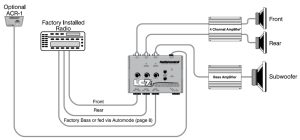
One stereo RCA pair is two channels. A pair that switches between rear and subwoofer duty serves one of those roles at a time. Three pairs can provide front, rear and subwoofer signals separately. Decide whether you need independent fader control, a separate bass level and an amplifier for the cabin speakers before choosing the cheaper output layout.
For a powered under-seat subwoofer, one configurable subwoofer pair can be enough while the receiver powers the main speakers. For a larger system with separate front/rear amplification, three pairs are easier to work with. See the under-seat subwoofer guide for a compact bass upgrade that preserves cargo space.
RMS power and speaker impedance
The maximum “50 watts × 4” headline is not the continuous output you should use to plan a speaker system. Kenwood and JVC specify 22W × 4 full-bandwidth power at less than 1% distortion for these models; Alpine specifies 18W × 4 at CTA-2006. Rating conditions matter, so those numbers do not establish an audible winner by themselves.
The Kenwood and JVC specifications call for 4–8Ω speakers. Some factory premium systems use lower-impedance speakers or an existing amplifier with a special signal path. Do not connect that system as if it were four ordinary aftermarket speakers. An integration interface, retained amplifier or different upgrade plan may be required.
Tuning features that are actually worth paying for
A high-pass filter is useful for relieving smaller speakers of deep bass. A low-pass filter limits the upper frequencies sent to a subwoofer. Time alignment can improve arrival-time balance at a chosen seat. EQ can make measured or carefully judged tonal corrections. These are useful tools, but they cannot repair a damaged speaker, a poor mounting seal or an incorrectly wired channel.
I would start with crossovers, level balance and speaker polarity before making large EQ boosts. If an amplifier or DSP already handles those tasks, avoid stacking conflicting filters and adjustments without a plan. The most elaborate tuning menu is not automatically the best one for an owner who only needs a straightforward replacement radio.
Before you order: work through the installation
| Check | What to write down | Why it matters |
|---|---|---|
| Vehicle | Year, model, trim, market, original radio and premium audio | Determines kit and interface application. |
| Space | Usable depth plus plug and cable space | A matching front opening does not prove rear clearance. |
| Functions to retain | Steering controls, chimes, amplifier, factory USB and other radio-related functions | Some require a data interface rather than a passive harness. |
| Listening sources | Bluetooth, USB, CD, local radio, satellite radio | Avoid paying for sources you will not use. |
| Next upgrade | No amp, powered sub, four-channel amp, or both | Determines how many independent outputs are useful. |
| Total budget | Radio + installation parts + fitting + optional tuner/amp | The lowest receiver price may not produce the lowest useful upgrade cost. |
Before the dash is reassembled, check radio reception, each speaker channel, balance/fader, Bluetooth calling, microphone pickup and the supported retained controls. If presets disappear when the ignition turns off, diagnose the power connections against the vehicle interface and radio diagrams. Do not randomly swap wires simply because the colors look familiar.
Frequently asked questions
What is the best single-DIN car stereo for most people?
I would choose the Kenwood KMM-X705 for an owner who wants an upgrade that can grow into an amplified system. For a basic Bluetooth replacement with four radio-powered speakers, I would save money with the JVC KD-X280BT. The best choice depends more on the intended system than the brand badge.
Can a single-DIN car stereo have CarPlay?
Yes, some single-DIN chassis receivers use floating or flip-out touchscreens and support CarPlay. The five conventional radios reviewed here do not. Check wired versus wireless support on the exact touchscreen model and measure the display’s clearance as well as the radio cavity.
Will a new radio make factory speakers sound better?
It can provide useful source options and tuning, but it cannot guarantee a sound-quality improvement in every vehicle. A retained factory amplifier, low-impedance speakers, factory EQ or a damaged speaker can change the result. If the main complaint is missing deep bass, a suitable subwoofer may address it more directly than replacing an otherwise usable radio.
Do I need an amplifier?
Not for a modest system using suitable speakers within the receiver’s supported impedance. You should consider one when you want substantially more clean output, when your speaker choice needs it, or when you are building a larger system. A passive subwoofer needs its own suitable amplification; a powered subwoofer already contains an amplifier.
Will factory steering-wheel controls still work?
Only with the appropriate supported connection. A radio described as steering-wheel-control ready still usually needs a vehicle-specific interface and correct setup. Check the interface application, supported radio connection and retained functions before ordering.
Can I install a single-DIN radio in a double-DIN opening?
Often, with an application-specific kit that provides a pocket or filler panel. Confirm the kit’s fit for your exact vehicle and the receiver’s mounting method. The spare space is useful only if the radio is securely mounted and the trim fits properly.
My final choice
Buy the KMM-X705 if system expansion is part of your plan, the KD-X280BT if you want a sensible Bluetooth replacement, or the KDC-X705 if you still use CDs. The Alpine earns its place through simpler controls and separate outputs; the Pioneer earns its place through Smart Sync. Choose the signal path and physical fit first, then the extra features.