
As an Amazon Associate & Influencer, we earn from qualifying purchases you might make if you click any of the links or buttons on this page at no expense to you.
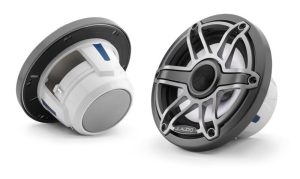
The Skar TX65 is the better buy for a 6.5-inch coaxial upgrade when you want more continuous power handling and have room for its deeper basket. Choose the RPX65 when the priority is a lower-cost replacement on a modest system, or its shallower mounting depth makes the installation easier. Both are 4-ohm coaxials sold as a pair. Neither turns a low-powered factory radio into a high-output system.
For this Skar RPX vs TX comparison, the most useful starting point is RPX65 versus TX65: the same nominal size and speaker layout. The TX65C component set is a separate option for a front-stage installation with individual tweeter locations. Other sizes have different ratings, so the series badge alone is not enough to choose an amplifier or confirm fit.
Before buying: confirm the exact speaker location, available depth, factory impedance and whether that location receives a full-range signal. A 6.5-inch label does not establish vehicle fit, and replacing a low-impedance factory speaker with a 4-ohm model can reduce available output.
LOWER-COST COAXIAL
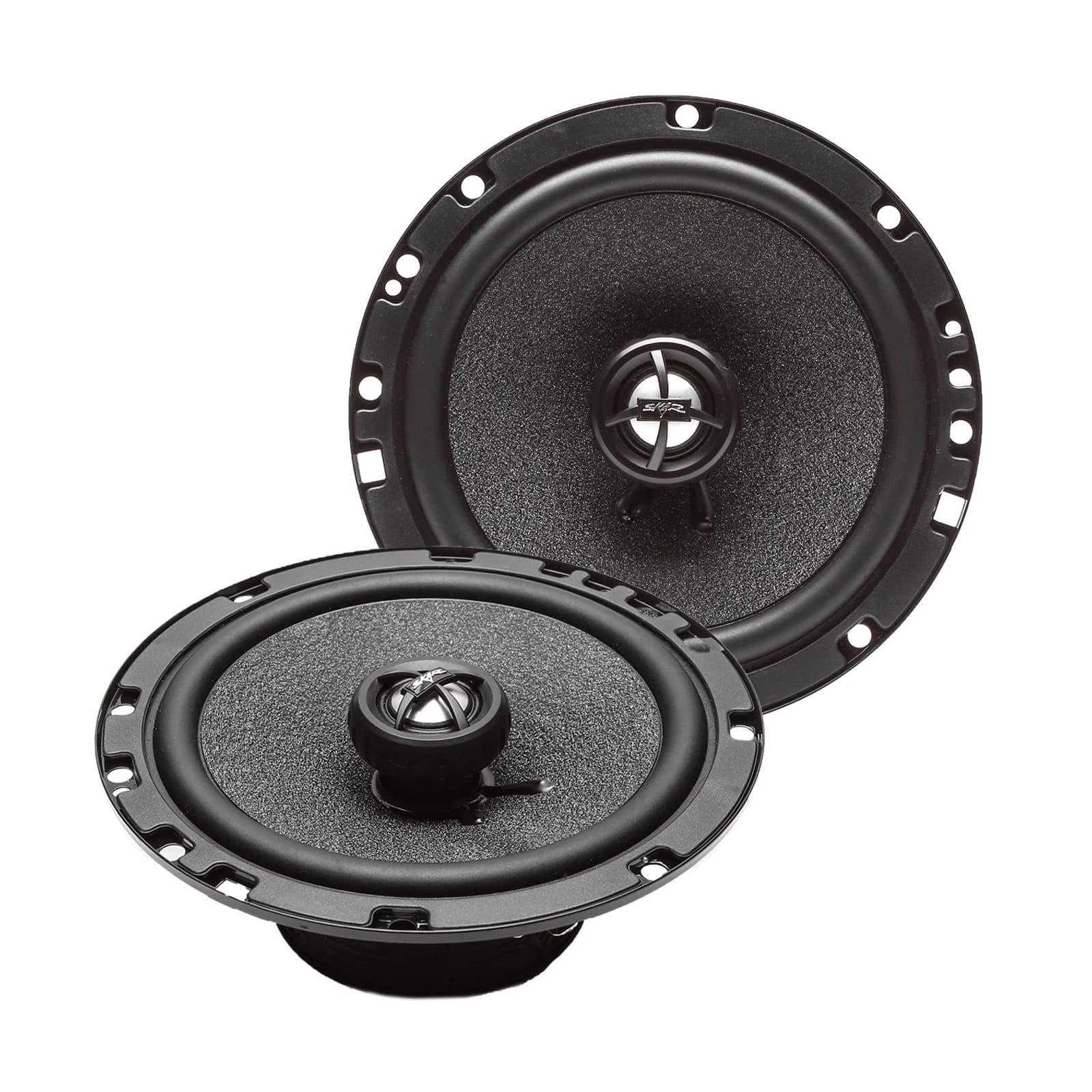
Skar RPX65
A sensible replacement when budget and a shallower fit matter more than amplifier headroom.
30 W RMS per speaker; confirm the 4-ohm load and full-range signal.
OUR COAXIAL PICK
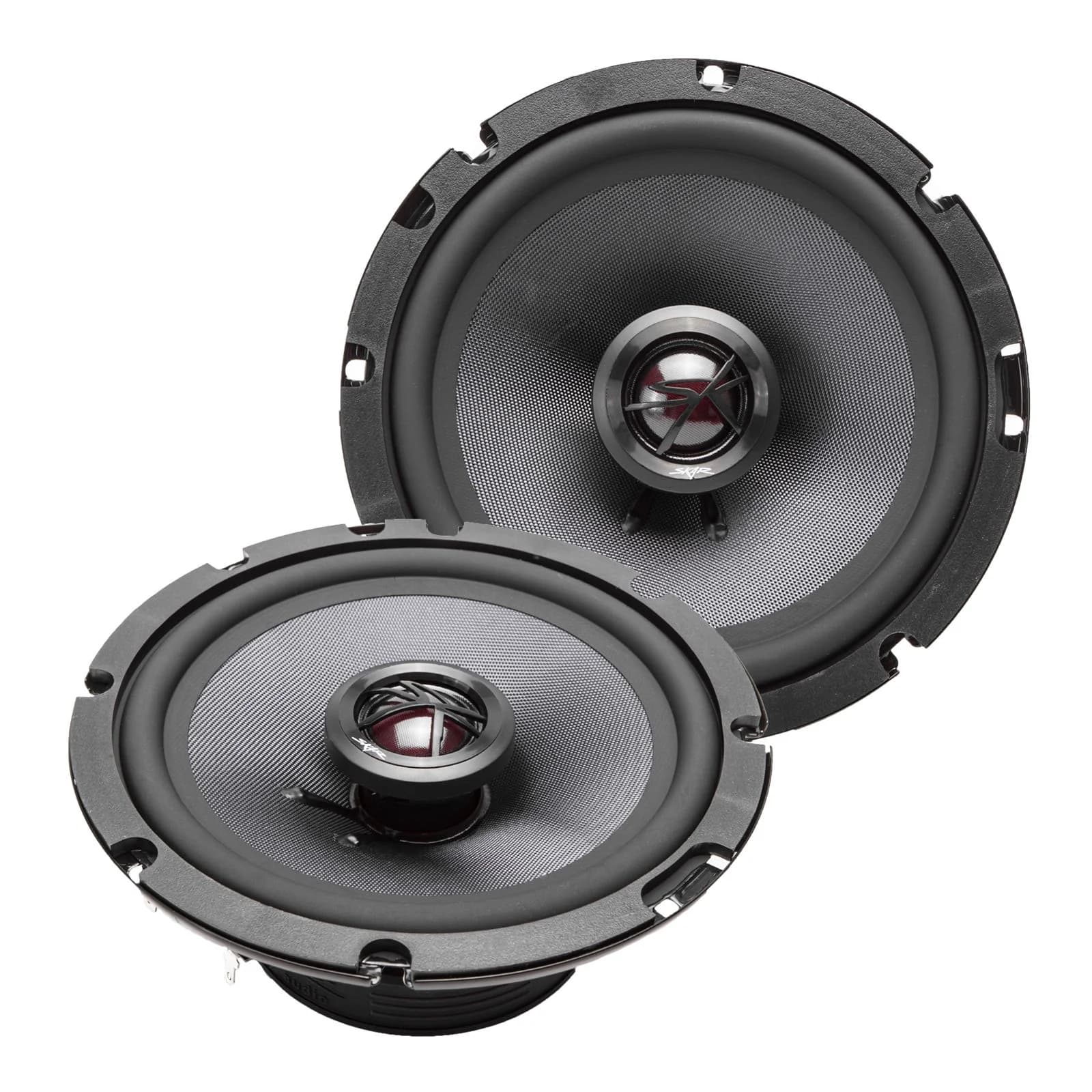
Skar TX65
The stronger choice for a planned upgrade with more clean amplifier power available.
50 W RMS per speaker; needs more rear clearance than RPX65.
| Speaker / role | Best reason to choose it | Main limit | Current price |
|---|---|---|---|
| Skar RPX65 6.5-inch coaxial pair | Lower-cost replacement; 2.21-inch listed mounting depth. | 60 W RMS per pair / 30 W each; not a subwoofer or universal factory-system fit. | Check Current Price on Amazon |
| Skar TX65 6.5-inch coaxial pair | 100 W RMS per pair / 50 W each for a more capable amplified setup. | 2.46-inch listed mounting depth; higher power handling alone does not guarantee more volume. | Check Current Price on Amazon |
Jump to: Actual specifications · Sound and bass · Factory radio or amplifier · RPX65 review · TX65 review · TX65C alternative · Fitment and parts · Other sizes · FAQs
Skar RPX65 vs TX65: the differences that matter
| Specification | RPX65 | TX65 |
|---|---|---|
| Speaker type / quantity | Two 6.5-inch two-way coaxials | Two 6.5-inch two-way coaxials |
| Nominal impedance | 4 ohms per speaker | 4 ohms per speaker |
| Continuous rating, pair | 60 W RMS | 100 W RMS |
| Continuous rating, each speaker | 30 W RMS | 50 W RMS |
| Peak rating, pair | 200 W | 200 W |
| Tweeter | Approximately 20 mm aluminum dome | 1-inch silk dome |
| Woofer / surround | Microfiber paper / butyl rubber | Glass fiber / TPE |
| Listed sensitivity | 89 dB; measurement reference not specified | 89 dB; measurement reference not specified |
| Listed frequency range | 40 Hz–20 kHz; response tolerance not specified | 45 Hz–20 kHz; response tolerance not specified |
| Mounting depth | 2.21 inches | 2.46 inches |
| Cutout diameter | 5.50 inches | 5.63 inches |
| Outside diameter / total height | 6.55 / 2.90 inches | 6.50 / 2.99 inches |
The biggest useful power difference is 30 W versus 50 W RMS per speaker, not a 200 W versus 240 W contest. Both of these particular pairs are labeled 200 W peak. For amplifier planning, use the continuous per-speaker rating and the amplifier’s output into a 4-ohm load.
RMS POWER · MATCHED 6.5-INCH PAIRS
Read the per-speaker number before choosing an amp
RPX65 · 60 W RMS per pair
30 W per speaker
TX65 · 100 W RMS per pair
50 W per speaker
One speaker → one suitable amplifier channel.
Compare 30 W or 50 W per channel at 4 ohms, rather than treating a pair rating as the rating of each speaker.
Bars show the manufacturer’s continuous power-handling ratings divided equally between two speakers. They do not show measured loudness or sound quality. Both pairs carry a 200 W peak rating.
Which sounds better: RPX or TX?
TX is the more attractive route when you are building around the speakers: it gives the TX65 more continuous power capacity and a different woofer/tweeter assembly. That is where the extra spend makes sense. In a straightforward replacement driven by the same modest factory radio, the installation and factory signal can matter more than the move from RPX to TX.
The TX65 uses a silk-dome tweeter; the RPX65 uses an aluminum dome. Do not choose solely on “silk is smooth” or “metal is harsh.” Tweeter level, crossover design, mounting angle and the cabin all affect the result. A door-mounted tweeter firing across your legs also has different placement limits from a separate tweeter mounted higher in the cabin.
For the driver’s seat, spend first on a suitable front pair and a sound installation. Expensive rear speakers are a weak first move if the front speakers are damaged or poorly mounted. RPX at the rear and TX at the front is a reasonable budget split when all locations, loads and signals are compatible; it is not necessary to match a series badge in every position.
Which has more bass?
Neither is the right purchase if your main goal is deep bass. These are door or rear-deck speakers, and a published 40 Hz or 45 Hz lower limit does not tell you how loudly or evenly either reproduces that frequency in your car. The RPX65’s lower printed number is not evidence that it beats the TX65 for bass.
For tighter midbass, make the mounting rigid, seal the speaker to its adapter and keep the front and rear sides of the cone from leaking into one another through gaps around the mount. For the low notes that a door speaker cannot comfortably supply, plan a properly integrated subwoofer. Avoid trying to manufacture that output with heavy bass boost; it uses up the speaker’s excursion and the amplifier’s available headroom.
Can you run RPX or TX on a factory radio?
Yes, an external amplifier is not automatically required for either coaxial pair. A compatible factory radio can drive them at moderate output. The continuous rating is a handling limit, not a minimum wattage the speaker must receive before it works. TX65 does not need 50 watts on every song or become unsuitable simply because the radio supplies less.
The more important question is what you are replacing. If the original speakers are low impedance or unusually efficient, a 4-ohm replacement can be quieter at the same volume setting. A factory amplifier may also send a bass-only signal to the door woofer, while a separate dash tweeter handles the highs. A coaxial speaker in that bass-only location cannot restore frequencies the amplifier never sends to it.
| Your system | Better purchase direction | Check first |
|---|---|---|
| Basic radio, failed full-range speakers, tight budget | RPX65 is a practical starting point if its fit and load are suitable. | Original impedance, full-range output, mounting adapter and connector. |
| Aftermarket receiver, no amplifier planned | Either can work; favor RPX for cost or TX if you will use its extra headroom later. | Receiver’s continuous output and the complete installation cost. |
| External amplifier planned | TX65 is the stronger coaxial choice within its per-speaker rating. | Clean 4-ohm output per channel, gain setup, filtering and speaker fit. |
| Premium factory amp with separate woofer/tweeter channels | Plan integration before choosing either coaxial. | Actual channel bandwidth, factory processing and speaker impedance. |
| Front locations suit separate tweeters | Consider TX65C rather than treating TX65 as a component kit. | Tweeter mounts, crossover space and a suitable full-range source. |
What amplifier power makes sense?
For these exact coaxials, plan around 30 W RMS per RPX65 or 50 W RMS per TX65 at 4 ohms. That keeps the comparison on the same per-channel basis. An amplifier’s huge total or peak number is not the output that one speaker receives, and a 2-ohm rating is not its 4-ohm rating.
A more powerful amplifier requires a setup that keeps the speakers within their limits. Gain matches the signal level; it is not a safe universal percentage of the knob. Use the amplifier’s documented setup procedure or an installer’s measured adjustment. If the system distorts, reduce output and find the cause rather than assuming a larger speaker will cure a clipped source.
Skar RPX65 review: the sensible budget replacement
Choose it if: you want a lower-cost pair for a compatible full-range location and moderate listening levels.
Skip it if: you need deep bass, a confirmed drop-in fit for a premium factory system, or more continuous amplifier capacity.
The RPX65 earns its place by keeping the replacement simple. It combines the woofer and tweeter in one speaker, so there is no separate tweeter mount or external component crossover to find space for. That is useful when you want to replace a failed factory coaxial without turning the job into a front-stage rebuild.
Its other practical advantage over TX65 is clearance: Skar currently lists 2.21 inches of mounting depth and a 5.50-inch cutout. The quarter-inch depth saving can matter behind a moving window. It still needs the correct bracket, a secure seal and enough clearance in front of the tweeter; “shallower” does not mean it fits every door.
- Worth choosing: straightforward coaxial layout, lower spending priority and less depth than TX65.
- Main tradeoff: 30 W RMS per speaker leaves less continuous power capacity for an amplified upgrade.
- Package to buy: one RPX65 pair, meaning two speakers. Vehicle-specific brackets and wiring adapters are a separate fitment decision.
Choose RPX65 over TX65 when the saving keeps money available for the required adapters and installation. A properly seated RPX is a better purchase than a TX that forces a poor fit or leaves the door trim rattling. If you already have working RPX65 speakers, inspect those installation details before replacing them just for a higher series name.
See the RPX65 specifications and installation dimensions for the exact model.
Skar TX65 review: our pick for a more capable coaxial system
Choose it if: you want a coaxial pair with more continuous power capacity for a suitable amplified system.
Skip it if: rear clearance is tight, the car’s signal/load is unsuitable, or your real goal needs separate tweeter placement.
The reason to step up is the TX65’s 50 W RMS per speaker, together with its glass-fiber woofer and one-inch silk-dome tweeter. It is the coaxial pair to choose when you are improving the system around it and can use that extra continuous capacity. It remains a two-way speaker in one mounting location, so the change does not add the placement flexibility of a component set.
Pay attention to the space behind it. The current Skar Install data lists 2.46 inches of mounting depth and a 5.63-inch cutout. Both are larger than RPX65’s requirements even though each is sold as a 6.5-inch speaker. An adapter ring that accommodates one does not establish clearance for the other.
- Worth choosing: higher continuous power handling than RPX65 in the same basic coaxial format.
- Main tradeoff: more clearance and spending required; the radio still determines available power.
- Package to buy: one TX65 coaxial pair. TX65C is a different component set, and a two-pair bundle is a different quantity.
TX65 is worth the step up when the difference is a manageable part of the whole job and the installation can support it. On a basic radio with no amplification planned, the case is weaker: get the mount, wiring and signal right first. A higher power-handling rating is useful only when the rest of the system makes use of it.
See the TX65 specifications and installation dimensions before choosing a mounting adapter.
TX65 vs TX65C: choose the speaker layout before the series
TX65C deserves consideration when the car has suitable separate tweeter locations or you are willing to create them properly. Moving the high-frequency driver away from a low door location gives you placement options a coaxial cannot offer. That is a more meaningful design change than simply expecting a more expensive coaxial to lift the soundstage.
TWO DIFFERENT INSTALLATIONS
TX65 and TX65C solve different placement problems
RPX65 / TX65 · COAXIAL
Full-range channel
→ Woofer + tweeter in one speaker
The high-frequency driver stays in the same door or rear-deck location.
TX65C · COMPONENT
Full-range channel
→ Included crossover → separate woofer and tweeter
The tweeter can use a suitable separate mounting location; the crossover needs a protected place too.
Signal-path schematic for a conventional passive installation, not a vehicle wiring diagram. A factory system with separately filtered woofer/tweeter outputs needs an appropriate integration plan.
Skar TX65C: the component alternative for a planned front stage
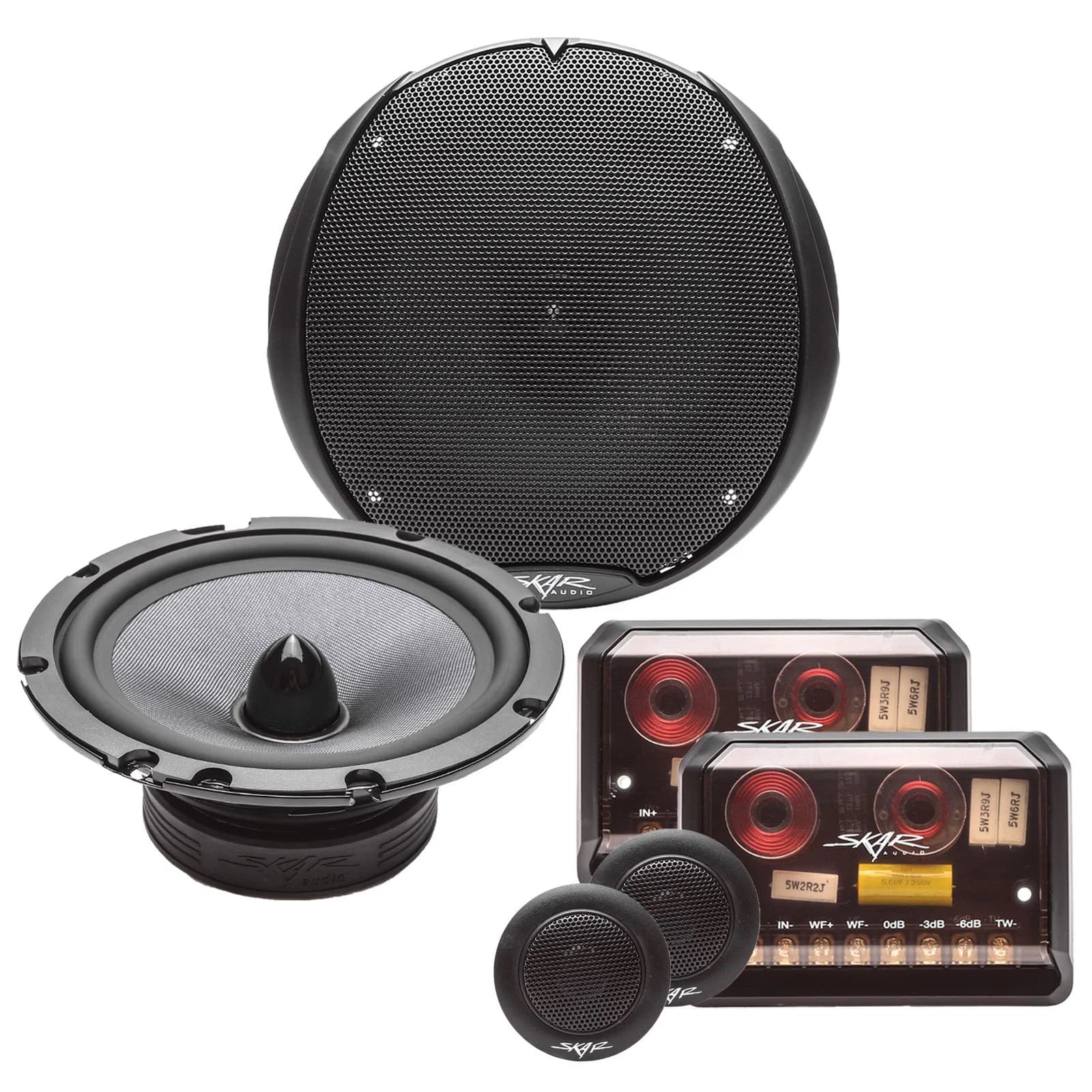
Choose it if: you have suitable separate tweeter locations and can mount the supplied crossovers correctly.
Skip it if: you want a simple one-location coaxial swap or have not resolved a factory system’s separately filtered outputs.
Choose TX65C for the installation layout, rather than for more watts: the set is rated 100 W RMS per pair, or 50 W per side. One side consists of a woofer, tweeter and crossover; that does not give each driver a separate 50 W allowance. Each side presents the specified 4-ohm system load when connected as intended.
The set includes two 6.5-inch woofers, two one-inch silk-dome tweeters and two external crossover networks. The Amazon component-set description also lists mounting hardware. Vehicle-specific brackets, wiring interfaces and a suitable protected crossover mounting location still need planning.
Use the supplied crossover arrangement for a conventional passive installation. Do not attach the tweeter directly to an unfiltered full-range amplifier output, or assume a factory woofer and tweeter channel can simply be joined together. A factory active system needs an integration plan matched to those outputs.
The extra work is justified when separate tweeter placement is a real objective. For a basic rear-door replacement, RPX65 or TX65 is usually the more sensible job. The TX65C product and Install details cover the woofer, tweeter and crossover dimensions separately.
What else you need: fitment, adapters and door preparation
The mounting ring, connection and factory signal deserve the same attention as the speaker. Build the parts list for the exact year, body style, trim and audio package. A speaker pair is not a vehicle-specific installation kit.
| Item / check | Required or optional? | What to establish |
|---|---|---|
| Vehicle-specific mounting adapter | Required where the factory mount differs | Bolt pattern, cutout, secure support and sealing; measure total depth after adding the adapter. |
| Speaker connector adapter / suitable terminals | Required for a sound connection | Match the vehicle plug and speaker terminals; preserve polarity and secure the connection. |
| Factory signal and amplifier integration | Required compatibility check | Nominal load, full-range versus filtered channel and factory processing. |
| Window and trim clearance | Required physical check | Window fully lowered, magnet/wire clearance, front tweeter height and door-panel fit. |
| Seal / gasket at the mounting interface | Required for a sound mounting seal | Prevent leaks around the flange without blocking drains or interfering with moving parts. |
| Door damping and rattle treatment | Optional, condition-dependent | Treat loose trim and resonant panels while retaining drainage and the vehicle’s moisture protection. |
| Amplifier and associated installation parts | Optional, system-dependent | Correct signal interface, output/load, wiring protection and gain setup. |
| Separate tweeter/crossover mounting | Required for TX65C | Suitable placement, weather protection and wiring; not needed as an external component kit for RPX65/TX65. |
Check these points before reinstalling the door panel
- Dry-fit the speaker and adapter. Check the actual unit against the available opening and both front and rear clearance.
- Protect the door’s working parts. Keep wiring away from the window mechanism and preserve drainage and moisture protection. Follow the vehicle’s service procedure for trim, electrical work and any airbag-adjacent parts.
- Confirm polarity and channel assignment. A reversed speaker can reduce bass when the two sides play together; a loose connection can imitate a failed driver.
- Test at low level first. Check left/right playback, window movement and trim clearance before increasing output.
- Set filtering and levels for the system. A high-pass filter can reduce deep-bass demand on the door speakers, especially with a subwoofer. It is a separate function from the crossover that protects and divides the woofer/tweeter paths.
If bass becomes weaker after the swap, check polarity, mounting leaks and the factory impedance/signal before buying another series. If vocals lack high-frequency detail, find out whether that channel is filtered. If the sound is clean until a particular volume and then breaks up, investigate source or amplifier clipping and speaker limits.
Do the same RPX-versus-TX rules apply to other sizes?
The general roles carry across the ranges, but the numbers do not. For example, TX4 is currently listed as shallower than RPX4, while TX65 is deeper than RPX65. TX also offers small coaxial sizes absent from the RPX lineup. Choose the size and exact model first; use its own Install and Specifications data.
| Nominal size | RPX / TX models | RMS handling per pair | Listed mounting depth, RPX / TX |
|---|---|---|---|
| 4 inch | RPX4 / TX4 | 30 / 60 W | 1.99 / 1.89 inches |
| 4 × 6 inch | RPX46 / TX46 | 45 / 70 W | 2.06 / 2.18 inches |
| 5.25 inch | RPX525 / TX525 | 45 / 80 W | 1.80 / 2.04 inches |
| 6.5 inch | RPX65 / TX65 | 60 / 100 W | 2.21 / 2.46 inches |
| 6 × 8 inch | RPX68 / TX68 | 70 / 100 W | 2.49 / 2.62 inches |
| 6 × 9 inch | RPX69 / TX69 | 90 / 120 W | 2.91 / 3.40 inches |
Use the RPX range and TX range to locate the exact size’s official specifications. A 6×9 rear deck and a 6.5-inch door are different installations, so comparing those models does not isolate a series difference.
Is TX worth upgrading to if you already own RPX?
Keep working RPX speakers when the current system already meets your needs. Upgrade to TX65 when you can identify a reason the additional continuous power capacity will help and the deeper mounting requirement is acceptable. Choose TX65C when the goal is separate tweeter placement and you are prepared for that installation.
If the complaint is missing low bass, spend toward the appropriate bass solution. If the complaint is a rattle, fix the mounting or trim. If a factory amplifier supplies a limited signal, address integration. Replacing good speakers while leaving the cause untouched is an expensive way to hear the same problem.
Frequently asked questions
Is Skar TX better than RPX?
For a compatible 6.5-inch coaxial installation with more clean amplifier power available, TX65 is the stronger choice: it handles 50 W RMS per speaker versus RPX65’s 30 W. RPX65 remains the better budget choice and needs less mounting depth. The answer can change for another size or factory-system configuration.
Is TX65 rated at 100 watts RMS per speaker?
No. Skar lists 100 W RMS for the TX65 pair, which is 50 W per speaker. RPX65 is 60 W RMS per pair, or 30 W each. Both of these 6.5-inch coaxial pairs carry a 200 W peak rating.
Do RPX or TX speakers need an amp?
Not automatically. A suitable radio can run either coaxial pair at moderate output. Check the original speaker impedance and channel bandwidth before using a factory system. An external amplifier adds useful clean output only when its signal integration, load and setup suit the speakers.
Which is louder on a stock radio?
The power-handling label does not answer that. Both 6.5-inch models list 89 dB sensitivity without a stated measurement reference on the current page, and the factory radio supplies the power. The original speaker load, actual efficiency and installation all affect available output.
Will either pair add enough bass without a subwoofer?
They can serve the door-speaker job, but neither is a substitute for a subwoofer when you want strong deep bass. A sealed, rigid mount and correct polarity help midbass. A printed lower frequency limit is not a guaranteed in-car bass result.
Can I mix TX in front and RPX in the rear?
Yes, when the sizes, channel loads and signal paths suit each location. Give the front installation priority if the driver’s seat is the main listening position. Matching the series throughout the car is less important than correct fit and integration.
Are TX65 and TX65C interchangeable?
No. TX65 is a coaxial pair with a tweeter in each speaker. TX65C is a component set with separate woofers, tweeters and crossover networks. The component set needs mounting and wiring for all those parts; a vehicle’s separate factory tweeters do not by themselves establish compatibility.
Will a 6.5-inch RPX65 or TX65 fit my car?
Nominal size is only the starting point. Check the exact opening, cutout, bolt pattern, mounting depth, window travel, front clearance, connector and factory audio package. Use model-specific measurements and the actual received speaker before making permanent changes.
Our final recommendation
Choose RPX65 for a compatible budget replacement; choose TX65 for a more capable coaxial system that can use its extra continuous power handling. Move to TX65C when separate tweeter placement is the objective. In every case, make the fit, signal and installation work before spending on a higher series badge.