As an Amazon Associate & Influencer, we earn from qualifying purchases you might make if you click any of the links or buttons on this page at no expense to you.
Start with the Kicker 46CSC44 when you need a compatible 4-ohm pair and clearance under the factory grille matters. Compare the Kenwood KFC-1066S for a shallower basket, or the Skar TX4 for a 4-ohm silk-dome option. Choose the JBL Club 44F only when your source is documented to support its 3-ohm load. The Rockford Fosgate R14X2 adds a shallow 4-ohm, 30W RMS alternative with grilles. Use the fit and system checks below to narrow the list before comparing current offers.
“4-inch” is only the size category: confirm the vehicle’s year, trim, audio system, speaker position, cutout, depth, grille clearance and original impedance. These are coaxial pairs; they are not universal replacements for factory woofers, separate tweeters or every premium-audio system.
Quick picks: three ways to choose
Start here for 4-ohm fit
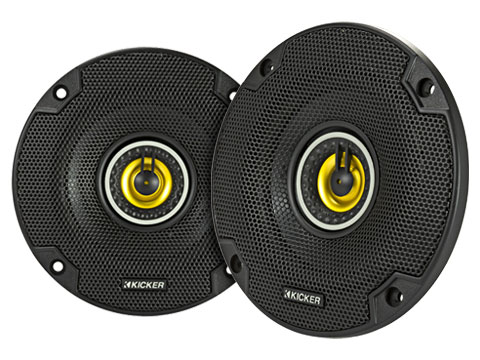
Kicker 46CSC44
A 4-ohm pair with zero tweeter protrusion and documented mounting dimensions.
Skip it if: the cutout, depth or factory amplifier load does not match.
Shallower option
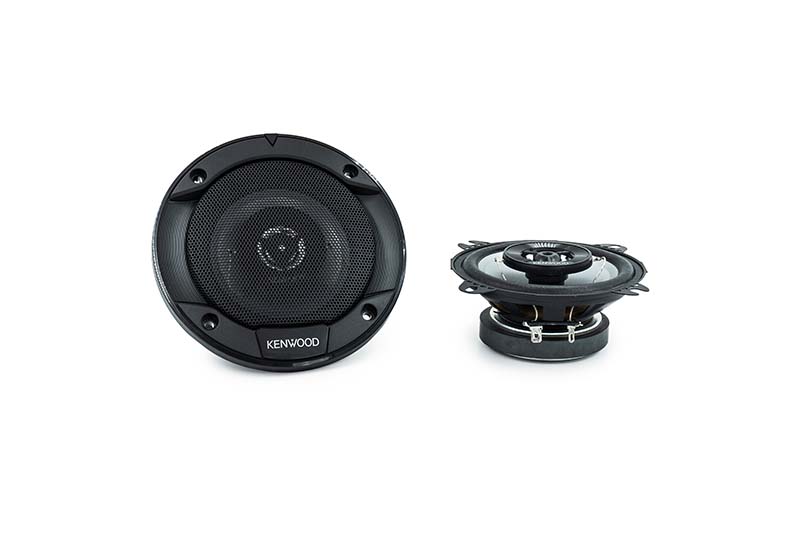
Kenwood KFC-1066S
A 43mm mounting depth and 21W rated input; check the 8mm tweeter height.
Skip it if: you need the zero-protrusion layout of the Kicker or plan a high-power amplifier build.
Check 3-ohm compatibility
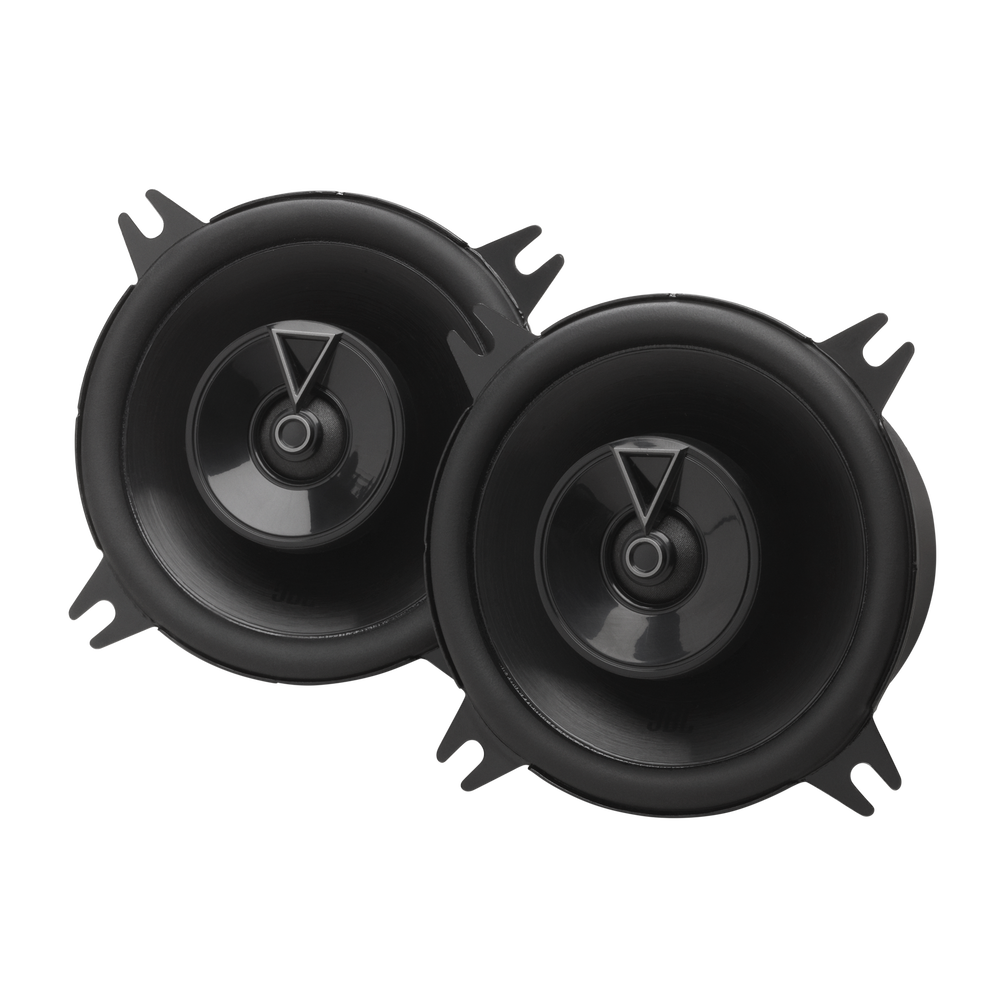
JBL Club 44F
A silk-dome pair with 35W RMS handling per speaker; confirm the amplifier accepts 3 ohms.
Skip it if: the source requires a 4-ohm minimum load or its compatibility is unknown.
Compare the best 4-inch car speaker pairs
| Speaker pair / best for | Impedance / useful power rating | Mounting / key limitation | Amazon |
|---|---|---|---|
| Kicker 46CSC44 Best for tight grille clearance | 4Ω; recommended amplifier range 10–50W RMS per speaker | 95mm cutout; 46mm top-mount depth; zero tweeter protrusion. | Check Current Price on Amazon |
| Kenwood KFC-1066S Best shallower 4-ohm option | 4Ω; 21W rated input per speaker | 92.6mm cutout; 43mm depth; 8mm tweeter height. | Check Current Price on Amazon |
| Skar Audio TX4 Best 4-ohm silk-dome alternative | 4Ω; 60W RMS per pair = 30W per speaker | 3.64-inch cutout; 1.89-inch depth; check factory grille clearance. | Check Current Price on Amazon |
| JBL Club 44F Best for compatible 3-ohm systems | 3Ω; 35W RMS per speaker; silk-dome tweeter | 92.1mm cutout; 49.3mm depth; standard package has no grilles. | Check Current Price on Amazon |
| Rockford Fosgate R14X2 Best shallow 30W RMS option with grilles | 4Ω; 30W RMS per speaker; grilles and hardware included | 43.6mm mounting depth; verify cutout and grille clearance from the drawing. | Check Current Price on Amazon |
Jump to: Choose by your situation · Head-to-head decisions · Required extras · Purchase worksheet · FAQs
Choose 4-inch speakers by your installation
| Your situation | Start with | Required confirmation |
|---|---|---|
| Very little room beneath the factory grille | Kicker 46CSC44 | Zero tweeter protrusion helps; still verify its 95mm opening and rear space. |
| Rear basket depth is the main constraint | Kenwood KFC-1066S or Rockford R14X2 | 43mm versus 43.6mm listed depth; check front clearance and the complete drawings. |
| You want a 4-ohm silk-dome coaxial | Skar TX4 or Rockford R14X2 | Compare 48mm versus 43.6mm depth and exact mounting/package requirements. |
| Your source explicitly supports a 3-ohm load | JBL Club 44F | Confirm load, 49.3mm rear depth and an available grille solution. |
| The factory position is a filtered midrange or component woofer | Map the existing system first | A coaxial replacement may not receive the signal or integration it needs. |
| Your main goal is strong low bass | Plan the bass system first | A small 4-inch coaxial should not carry the whole deep-bass requirement. |
The best pair is the one that passes the physical and electrical checks for your actual position. A brand recommendation becomes useful only after those checks. A dashboard location, door location and rear factory position can need different solutions even in the same vehicle.
1. Kicker 46CSC44 — Best for tight grille clearance
Choose it if: you need a 4-ohm coaxial pair and have limited clearance above the mounting surface.
Skip it if: the cutout, depth or factory amplifier load does not match.
The 46CSC44 is the first pair to check when you want a conventional 4-ohm replacement and the factory grille leaves little room above the speaker. Kicker specifies zero tweeter protrusion, a useful fit detail that a headline wattage cannot tell you.
Key features
- Type and quantity: 4-inch two-way coaxial speakers, sold as a pair.
- Electrical: nominal 4-ohm load; the manual recommends 10–50W RMS amplifier power per speaker.
- Top-mount fit: 95mm cutout and approximately 46mm mounting depth.
- Above the flange: zero tweeter protrusion; grilles included.
Its zero-protrusion layout makes it worth checking under a close-fitting factory grille. A coaxial places the tweeter in the same assembly as the woofer, so it can suit an existing full-range speaker position without separate tweeter mounting.
A sensible first comparison under factory trim
If the speaker sits beneath the original grille, the zero-protrusion specification gives you a useful starting point. Compare the 95mm cutout and screw arrangement next, then include any adapter in both depth and front-clearance measurements. Do not enlarge an opening solely because a nominal 4-inch label sounded right; identify a documented mounting solution before purchase.
Installation and limitations
Measure the vehicle opening and the room behind it, then confirm the screw pattern and connector adapter. The zero-protrusion figure helps with the original grille, but mounting tabs, surrounding trim and the included grille still need checking. If a spacer is required, account for the way it changes both rear depth and front clearance.
The 150W peak figure is not a 150W continuous amplifier recommendation. Nor does a 4-ohm speaker automatically match every factory system: some premium-audio positions use different loads or receive a filtered signal. Confirm the factory amplifier and speaker position before treating this as a direct replacement.
See Kicker’s exact 46CSC44 specifications and the 2019 CS coaxial manual.
Buying the Kicker 46CSC44? Check the selected model, package, seller and condition before ordering.
2. Kenwood KFC-1066S — Best shallower 4-ohm option
Choose it if: a shallower basket matters and you have enough clearance above the mounting flange.
Skip it if: you need the zero-protrusion layout of the Kicker or plan a high-power amplifier build.
The KFC-1066S is worth checking when rear clearance is the main constraint. Kenwood specifies 43mm mounting depth, slightly less than the Kicker’s top-mount figure. The front side of the installation needs equal attention because the tweeter rises above the mounting surface.
Key features
- Type: 4-inch two-way coaxial pair with a polypropylene woofer cone.
- Electrical: 4-ohm nominal impedance and 21W rated input.
- Fit: 92.6mm cutout, 43mm depth and 8mm tweeter height.
- Package: two grilles, mounting hardware and short speaker cables listed by Kenwood.
The rated input is a more useful planning number than Kenwood’s 220W peak-input label. A modest-power radio installation may be a sensible role after confirming the radio’s output and the original load. The rating does not prove that a particular factory radio will produce a certain loudness.
Use the shallow basket without overlooking the front
When rear space is the limiting measurement, put Kenwood and Rockford at the top of the drawing comparison. If front space is tighter, compare the Kenwood’s tweeter height with the Kicker’s zero-protrusion design. For an amplified upgrade, retain the 21W rated-input label in your plan rather than treating the much larger peak figure as a setup target.
Installation and limitations
Check the original grille with an 8mm-high tweeter in mind, and measure rear clearance with the window and other moving parts through their full travel. Included cables and screws do not replace a vehicle-specific speaker plug adapter or mounting bracket. Confirm the Amazon package is the standard two-speaker set.
A shallower basket does not make it a universal shallow-fit replacement. Its lower rated input also gives you a reason to compare the Kicker or another suitable speaker if an external amplifier is planned. Match amplifier settings to the speaker and avoid using peak labels to set gain.
See Kenwood’s electrical, dimensional and package specifications.
Buying the Kenwood KFC-1066S? Check the selected model, package, seller and condition before ordering.
3. Skar Audio TX4 — Best 4-ohm silk-dome alternative
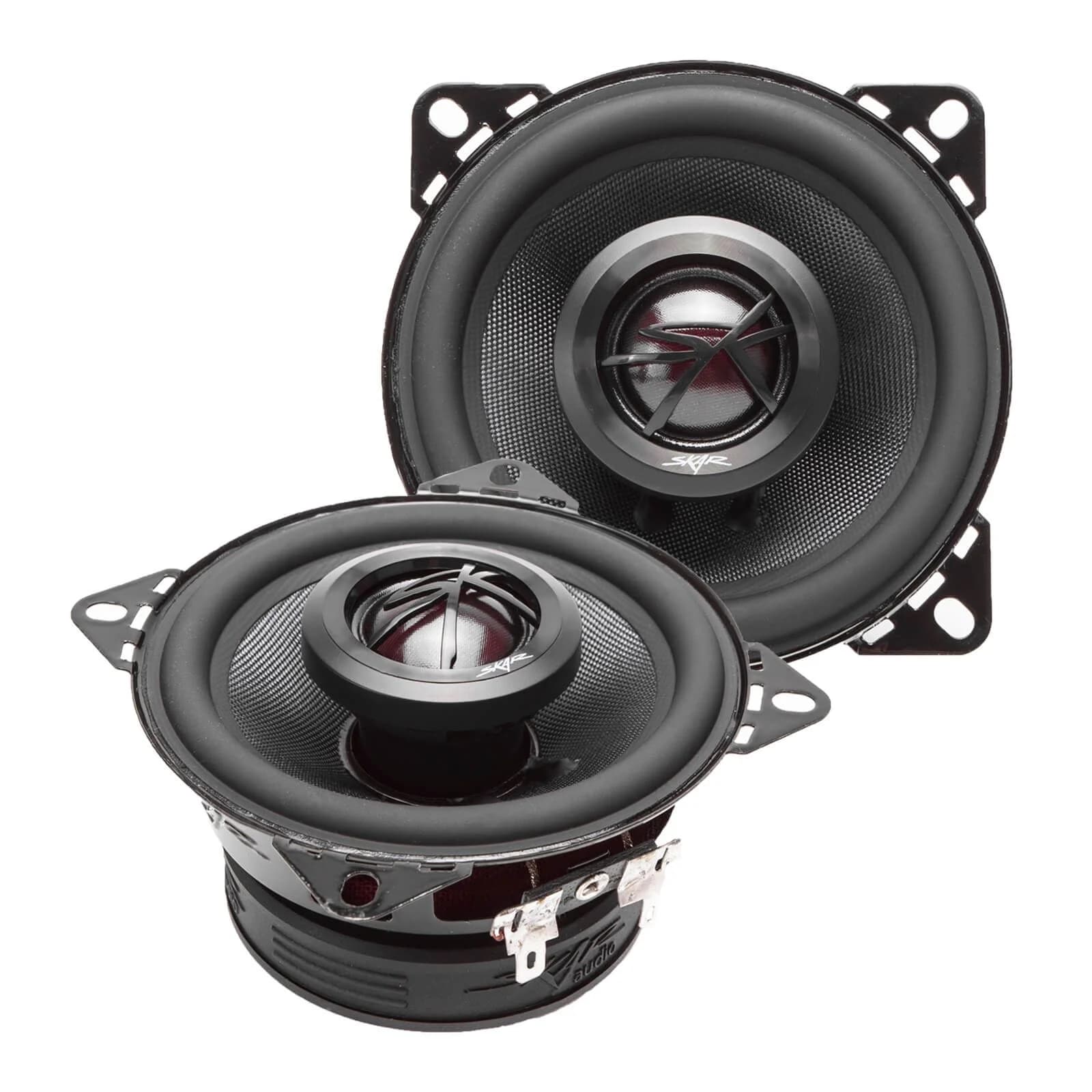
Choose it if: you want a silk-dome coaxial pair for a compatible 4-ohm position and have the required depth.
Skip it if: you read its 120W title as continuous power for each speaker or need a shallower basket.
The TX4 combines a fiberglass woofer cone with a 1-inch silk-dome tweeter. It gives you another documented construction option while keeping a nominal 4-ohm load; fit and the source signal remain the first checks.
Key features
- Quantity: a pair of 4-inch two-way coaxial speakers.
- Power: 60W RMS for the pair, equivalent to 30W per speaker; 120W peak is also a pair rating.
- Impedance: nominal 4 ohms for each speaker.
- Fit: 3.64-inch cutout and 1.89-inch mounting depth; total height 2.55 inches.
Choose it if its construction and dimensions suit your planned installation, particularly when you want a silk-dome option while keeping a 4-ohm load. How it sounds will also depend on the mounting seal, source signal, equalization and listening position.
When it belongs on your shortlist
Shortlist the TX4 when a 4-ohm coaxial with its documented construction fits your source and mounting space. Its roughly 48mm depth makes it a different physical candidate from the shallower Rockford. Write 30W RMS each on the amplifier worksheet: the 60W figure is the pair total. That simple check prevents buying or configuring around twice the per-speaker rating.
Installation and limitations
Skar’s depth converts to roughly 48mm, so compare the actual opening with the Kenwood’s 43mm before ordering. Check top clearance using the installation drawing rather than assuming the total-height figure equals tweeter protrusion. Add the correct vehicle brackets and connector adapters where needed; do not assume protective grilles are included.
The pair-based power figures are easy to misread in retailer titles. Use 30W RMS per speaker for this comparison, rather than 60W each or 120W continuous. These are still small full-range speakers, so a silk dome or a higher peak label does not make them a substitute for a subwoofer.
See Skar’s TX4 specifications and installation dimensions.
Buying the Skar Audio TX4? Check the selected model, package, seller and condition before ordering.
4. JBL Club 44F — Best for compatible 3-ohm systems
Choose it if: your amplifier or radio is documented to support the 3-ohm speaker load.
Skip it if: the source requires a 4-ohm minimum load or its compatibility is unknown.
The Club 44F belongs on the shortlist only after the electrical check. Its nominal 3-ohm impedance sets it apart from the three 4-ohm choices above. That can be appropriate for a documented application, but it is not permission to put a lower load on an unknown factory amplifier.
Key features
- Type and quantity: 4-inch two-way coaxial pair with silk-dome tweeters.
- Electrical: 3-ohm nominal impedance; 35W RMS and 105W peak per speaker.
- Dimensions: the manual shows a 92.1mm cutout and 49.3mm mounting depth.
- Package: two speakers and a foam gasket; protective grilles are not listed.
The sensible reason to choose the JBL is a compatible 3-ohm application combined with its documented construction and fit. Do not choose it from sensitivity alone: JBL’s 90dB figure is measured at 2.83V, while the Kicker and Kenwood publish 1W-based figures. Those numbers are not a like-for-like loudness ranking.
Order only after the load and grille checks pass
Write down the source’s supported load and the complete installed dimensions before treating the Club 44F as your preferred pair. If an exposed position needs grilles, add a compatible solution to the basket. If the factory grille remains, verify the whole assembly underneath it. Those checks are stronger purchase evidence than comparing a 2.83V sensitivity headline against another brand’s 1W figure.
Installation and limitations
Confirm the radio or amplifier’s minimum supported load for the channel driving these speakers. Measure the 49.3mm basket depth and allow clearance above the flange; the drawing shows 63.8mm total height. Use the correct mounting adapters and wiring. Keep a suitable original grille or plan separately for protection in an exposed mounting position.
This is the Club 44F, not the older Club 4020 or Stage3 427F. Specifications and mounting evidence for those models should not be transferred to it. If the source’s load support is unclear, resolve it first or choose a verified compatible alternative instead of assuming JBL’s branding establishes fit.
See JBL’s Club 44F product specifications and the exact-model installation drawing.
Buying the JBL Club 44F? Check the selected model, package, seller and condition before ordering.
5. Rockford Fosgate R14X2 — Best shallow 30W RMS option with grilles

Choose it if: you need a shallow 4-ohm pair, want supplied grilles, and your amplifier plan suits 30W RMS per speaker.
Skip it if: the complete mounting drawing or the factory channel’s load and signal does not match.
The R14X2 gives buyers a second shallow 4-ohm option beyond the Kenwood. Its manufacturer lists a 43.6mm mounting depth and 30W RMS power handling per speaker. The pair includes grilles and mounting hardware, which matters for an exposed installation where the factory grille will not be reused.
Key features
- Format: pair of 4-inch two-way coaxials with a polypropylene cone and silk-dome tweeter.
- Electrical: nominal 4-ohm load; 30W RMS and 60W maximum per speaker.
- Mounting: manufacturer-listed depth of 1.72 inches, or 43.6mm.
- Package and network: grilles and hardware included; integrated tweeter high-pass crossover.
Its depth is close to the Kenwood’s 43mm figure, while its continuous power-handling specification is higher than Kenwood’s 21W rated input. That makes it useful to cross-shop for a modest external-amplifier plan. These figures are purchase-planning differences, not evidence that one will sound better or play louder in your cabin.
Cross-shop it for a particular constraint
Compare it with Kenwood when rear depth is tight, and with Skar when you want a 4-ohm silk-dome option. Its 43.6mm depth and included grilles are documented reasons to investigate it. They are not a universal-fit or listening-performance claim. Use the official template to resolve the remaining hole and mounting checks before choosing a seller.
Installation and limitations
Use the R14X2 drawing and cutout template linked from Rockford’s official manual page to check the hole, screw pattern, front clearance and magnet space. The headline depth alone cannot confirm a drop-in fit. Supplied hardware does not include a vehicle-specific adapter for every car; retain that line in the installation budget.
The integrated high-pass network is for the tweeter. It is not proof that low bass has been filtered out of the complete speaker, and it does not replace any system-level crossover your amplifier or installation needs. Also distinguish this coaxial R14X2 from the R14X2-S component system, which uses separately mounted tweeters.
See Rockford’s exact R14X2 specifications and the official Prime manual and cutout-template page.
Buying the Rockford Fosgate R14X2? Check the selected model, package, seller and condition before ordering.
What else you need
Buying the pair is only part of a replacement. Check the complete mounting and signal path for each speaker position, especially in cars with premium factory audio.
| Item | When it is needed | Included or separate? |
|---|---|---|
| Mounting bracket or adapter | Required when the vehicle screw pattern or original housing does not match the new speaker. | Vehicle-specific; normally separate. A size-category match does not remove this check. |
| Connector adapters | Required when keeping the factory wiring without a correctly documented direct connection. | Vehicle-specific; separate. Match polarity and the actual plug at the speaker position. |
| Spacer and sealing gasket | Needed if documented for clearance or a proper mounting seal. | Do not prescribe a universal spacer. It reduces rear intrusion but increases front/grille clearance needs. |
| Protective grille | Required for an exposed position; a suitable original grille may provide protection. | Kicker and Kenwood list grilles. JBL’s package does not. Confirm Skar’s exact package before relying on grilles. |
| Compatible radio or amplifier | Required source for the chosen speaker load and signal range. | Existing equipment may be suitable after verification. JBL’s 3-ohm load needs explicit support. |
| Crossover or high-pass settings | Needed where specified by the system design, especially with an external amplifier. | Do not assume a coaxial’s integrated tweeter network supplies a whole-system bass crossover. Use the applicable manuals. |
| Vehicle-specific signal integration | Needed when replacing filtered factory speakers, retaining separate tweeters or changing an amplified system. | Application-specific design; separate parts may be necessary. Diagnose the original signal path first. |
Compare the mounting and electrical numbers together
| Exact model | Cutout / mounting depth | Load / useful power specification | Front clearance and package |
|---|---|---|---|
| Kicker 46CSC44 | 95mm / 46mm top mount | 4Ω / recommended 10–50W RMS amplifier range per speaker | Zero tweeter protrusion; grilles included. |
| Kenwood KFC-1066S | 92.6mm / 43mm | 4Ω / 21W rated input per speaker | 8mm tweeter height; grilles included. |
| Skar TX4 | 92.5mm / 48mm, converted from inches | 4Ω / 30W RMS per speaker (60W pair) | Check complete drawing and selected package; total speaker height ≈64.8mm. |
| JBL Club 44F | 92.1mm / 49.3mm | 3Ω / 35W RMS per speaker | Total height 63.8mm; no grilles in the documented box. |
| Rockford R14X2 | Use official cutout template / 43.6mm | 4Ω / 30W RMS per speaker | Grilles and hardware included; check front clearance in drawing. |
Kicker vs Kenwood: rear depth or grille clearance?
The Kenwood’s 43mm basket depth gives about 3mm more rear clearance than the Kicker’s 46mm top-mount figure. The Kicker’s zero tweeter protrusion can instead be useful when the factory grille sits close to the flange; Kenwood lists an 8mm tweeter height. Those are different clearance problems. A shallow basket can still fail under the grille, and a flush tweeter can still sit above a magnet that is too deep.
Use those numbers to choose which drawing to check first. They do not establish bolt-for-bolt interchangeability: the openings differ, screw positions still matter and the terminals need space. If both fit, compare the complete package and your source-power plan. Kenwood’s 21W rated-input specification and Kicker’s recommended amplifier range are differently labeled values, so avoid making a sound-quality ranking from them.
Kenwood vs Rockford: two shallow candidates
Their stated depths are close: 43mm for Kenwood and 43.6mm for Rockford. A difference smaller than a millimeter should not override a screw pattern, terminal clearance or adapter mismatch. Rockford specifies 30W RMS per speaker; Kenwood specifies 21W rated input. If a modest external amplifier is part of the plan, compare both speakers’ limits with that amplifier’s documented output and setup instructions.
Both manufacturers document grilles in the kit. That can avoid a separate grille purchase for a suitable exposed position, but neither grille is guaranteed to fit a factory trim panel. For Rockford, use the official cutout template rather than guessing a hole dimension from its nominal 4-inch size. If the original grille stays in place, measure underneath it as well.
Skar vs Rockford: matching load, different installation footprint
Both are 4-ohm silk-dome coaxial pairs with 30W RMS per-speaker figures. The Skar’s listed mounting depth is about 48mm, compared with Rockford’s 43.6mm. That makes mounting space a meaningful separator even though their headline power is similar. Check the Skar’s full assembly height and your front clearance, plus whether the chosen installation needs a grille or adapter.
A silk-dome label describes construction rather than proving a particular tonal result in your car. Door sealing, dashboard reflections, factory processing and listening position can change the result. Choose the construction you prefer only after fit, load and channel signal are known. A documented compatible mount is more useful than an unsupported “best sound” claim.
JBL vs the 4-ohm picks: resolve the amplifier load first
JBL’s 3-ohm nominal load is the first difference to resolve. At the same applied voltage, a lower nominal resistance draws more current; that does not mean every factory radio or amplifier supports it. Do not use a louder-is-better assumption to bypass the source’s load specification. Also budget for a grille if the installation needs one, since the documented Club 44F box does not include grilles.
JBL’s 90dB sensitivity is given at 2.83V. For an illustrative nominal resistive load, 2.83² ÷ 3 is about 2.67W, while the same voltage across 4 ohms is about 2W. That is why a 2.83V figure cannot be read as a 1W figure. Actual speaker impedance varies with frequency, and these headline specifications do not support an exact normalized loudness ranking.
A fit worksheet to complete before you buy
| Record or measure | What to include | Pass condition |
|---|---|---|
| Vehicle and audio system | Year, model, trim, factory amplifier/audio option and speaker position | Evidence applies to the exact configuration. |
| Hole and screw pattern | Opening shape/diameter, mounting tabs and screw centers | Basket and fasteners fit or a documented adapter solves them. |
| Rear space | Mounting-plane-to-obstruction distance, magnet and terminal room | New depth plus connections clears fixed and moving parts. |
| Front space | Flange-to-grille clearance, tweeter height and any new grille | Trim can close without touching the driver or grille. |
| Electrical load | Original specification and supported amplifier load | Replacement load is supported for that channel configuration. |
| Signal and wiring | Full-range or filtered feed, polarity and any separate tweeter | The new coaxial receives the intended signal without an unknown parallel load. |
| Additional parts | Brackets, spacers, connector harnesses, seals and grilles | Complete installed cost is known before checkout. |
Illustrative spacer example: a 46mm-deep speaker in a position with only 44mm behind the mounting plane cannot be assumed to fit. A correctly designed 3mm spacer could move the basket forward, reducing rear intrusion to about 43mm. It also moves the front assembly 3mm closer to the grille, changes the fastening arrangement and may affect the seal. That arithmetic is a planning example, not approval of a universal spacer or a particular vehicle fit.
Measure with the relevant trim and moving parts considered. A door opening can have clearance with the window up and a conflict as it moves down. A dashboard position can have a duct or harness behind the basket. Avoid treating a photograph of someone else’s trim level as a complete fit guarantee. If you cannot establish the source load or channel signal, an installer check has more value than guessing from the old cone diameter.
Factory radio, aftermarket head unit or external amplifier?
| System | What to check first | How to narrow these picks |
|---|---|---|
| Factory radio with an ordinary full-range feed | Documented supported load and original driver position | Compare compatible 4-ohm choices by fit; do not assume high peak watts mean more output. |
| Factory premium amplifier or separate tweeters | Channel load, crossover/processing and driver wiring | Resolve integration before substituting a coaxial. |
| Aftermarket head unit | Its continuous output/load specification and any crossover settings | Match load and setup; advertising “max watts” is not a speaker-output plan. |
| External amplifier | Output at the intended load, clean input and speaker limits | Compare per-speaker ratings and follow documented gain/filter setup. |
You do not automatically need a new amplifier simply because you install new speakers. Conversely, a new pair does not cure an amplifier problem or guarantee more useful volume from an existing radio. Start from the actual source and your objective: restore a failed driver, reduce rattles, improve integration or build an amplified system. Each objective changes what else belongs in the basket.
Tweeter crossover versus whole-speaker bass filtering
An integrated tweeter crossover directs an appropriate part of the signal to the tweeter. It does not establish that the small woofer is protected from all deep bass. Rockford explicitly describes its integrated network as a tweeter high-pass. A system-level high-pass filter on a suitable head unit or amplifier is a separate setting; use the documented requirements for your speakers and system rather than copying a universal cutoff or gain percentage.
Do not remove a factory filter or reconnect a separate tweeter without mapping the circuit. Some factory positions receive only a limited band from an amplifier. A coaxial installed there may have a tweeter that receives little appropriate signal, while adding a coaxial to an existing tweeter circuit can change the load. The solution depends on the factory design, not the presence of a second driver on the new speaker.
Diagnose the problem before replacing the pair
| Symptom | Check before ordering | Why a new pair may not solve it |
|---|---|---|
| One channel is silent | Balance/fader, connector, wiring and source channel | The fault may be upstream of the speaker. |
| Rattle only on certain notes | Loose trim, fasteners, bracket and mounting seal | A replacement can inherit the same loose installation. |
| Weak bass after installation | Polarity, source filtering and seal | A wiring or integration problem can affect the result. |
| Distortion as volume rises | Source/amp behavior, bass boost and speaker condition | More advertised peak watts do not repair a clipping source. |
For the purchase budget, add the pair, any exact-vehicle bracket, connectors, sealing materials, a grille solution and installation. Keep an external amplifier or subwoofer as a separate planned upgrade when your objective requires one. This prevents a low-priced pair from turning into a larger unplanned system rebuild.
How to choose 4-inch speakers that work in your car
Measure the opening and both sides of the flange
Measure the hole the basket passes through, the usable depth behind the mounting surface and the clearance above it. Also check the screw pattern, magnet clearance, connectors and nearby moving parts. The Kenwood has a 43mm mounting depth, the Kicker about 46mm, the Skar about 48mm and the JBL 49.3mm; none of those numbers includes every possible adapter.
A factory grille can rule out a speaker even when the basket fits. The Kicker’s zero tweeter protrusion is useful in that situation; the Kenwood specifies 8mm tweeter height. A spacer changes the installed position, so recheck the grille rather than treating extra depth as a free gain. Compare the manufacturer drawing to the actual vehicle opening.
Match impedance before choosing a brand
The Kicker, Kenwood and Skar are nominal 4-ohm speakers; the JBL is 3 ohms. Use the original equipment information and the source’s supported load, not a guess from speaker size. A lower impedance can demand more current from a source, and a higher impedance may change the available output. Neither change guarantees an improvement.
Factory premium systems may use uncommon loads or combine drivers on one channel. If the original speaker is part of a component or actively filtered system, map the amplifier channel and signal before replacing it with a coaxial. Adding another tweeter to a circuit without checking the design can change both the load and the response.
Read rated power without the peak-number trap
Skar publishes 60W RMS for the TX4 pair, which is 30W per speaker. JBL’s 35W RMS is per speaker. Kenwood lists 21W rated input. Kicker’s manual gives a recommended amplifier range of 10–50W RMS per speaker, rather than asking you to build around the peak label. These are different kinds of specification, so keep their labels attached.
Speaker power handling is not amplifier output, and it does not tell you how loudly a speaker will play on a factory radio. Set an external amplifier according to its instructions and the speakers’ limits. The gain control matches input level; it is not a universal volume percentage determined by the speaker’s wattage.
Do not rank mismatched sensitivity figures
A sensitivity figure needs its measurement basis. JBL specifies 90dB at 2.83V, while the Kicker and Kenwood publish 1W/1m figures. At different impedances, the same voltage does not represent the same electrical power. Skar’s short specification does not provide a matching basis for a direct ranking. These headline numbers therefore do not establish a loudest or best-sounding winner.
Set realistic expectations for bass
A 4-inch speaker is a small driver. Published frequency-response endpoints do not prove strong deep bass in your particular installation, and a two-way or high-peak-power label does not change that. Choose it to suit the existing position and system. If deep bass is the main goal, plan a compatible subwoofer system rather than expecting a small coaxial to do that job.
A rigid mount, a good seal and correct polarity matter to the result. Replacing a rattling mount or fixing a wiring fault may address a problem that a new speaker alone cannot. If only one side is silent, diagnose the connection and amplifier channel before buying another pair.
Checks before ordering and after installation
- Record the vehicle year, trim, factory audio option and exact speaker position.
- Verify the original load and whether the signal is full-range or filtered.
- Measure cutout, rear depth, screw spacing and clearance under the original grille.
- List the necessary brackets, spacers, connector adapters and any separate grille.
- Confirm the selected listing is the exact model and two-speaker package, with the seller and condition you want.
- After fitting, check polarity and each channel at low volume, then listen for rattles or distortion before increasing the level.
- Check windows and moving trim for clearance, and apply the system’s documented crossover settings.
Frequently asked questions
Will these fit any car with 4-inch speakers?
No. Nominal size does not fix the mounting depth, screw pattern, magnet dimensions or connector. The original amplifier load and signal also matter. Use the vehicle’s exact configuration and the new speaker drawing before deciding that a replacement fits.
Which is best with a factory radio?
Start with the factory radio’s supported impedance and the original speaker position. A compatible 4-ohm application may suit the Kicker, Kenwood or Skar. Their ratings do not prove that an unknown radio can drive them optimally. Do not choose the JBL’s 3-ohm load unless that source supports it.
Is the Skar TX4 rated at 60W RMS each?
No. The manufacturer’s 60W RMS figure is for the pair, equivalent to 30W per speaker. Its 120W peak figure is also a pair rating. Keep those quantities clear when comparing it with the other models.
Do I need a separate tweeter or crossover?
These are two-way coaxials with the tweeter in the speaker assembly. A separate tweeter mount is not part of the ordinary coaxial installation. A factory component system, active amplifier or system-level bass crossover can still require specific integration; the coaxial format alone does not resolve that.
Start with identifying the speakers in your car before selecting replacements. If the radio is also part of the upgrade, compare double-DIN head units and their audio connections.
Can I replace only one failed speaker?
First confirm the speaker is the fault. A single exact replacement can preserve the existing match if available; changing one side to a different model can give the channels different response and electrical characteristics. These selected offers are pairs, so compare the cost and installation scope of replacing both while retaining the same supported load.
Are 4-inch coaxials the same as 4-inch midrange or component speakers?
No. A coaxial includes its tweeter in the assembly. A midrange-only unit or component woofer has a different role and may need separate drivers, filtering and wiring. Match the function of the factory position as well as nominal diameter; a physical fit does not make those formats interchangeable.
Will these work in a boat or exposed installation?
Do not infer marine or weather resistance from a car-speaker listing. Check the exact model’s published environmental rating and intended use. If the position gets direct water exposure, choose a documented suitable product and wiring plan rather than relying on the nominal size or cone material.
The final choice
Choose the Kicker 46CSC44 first for tight factory-grille clearance in a compatible 4-ohm system. Compare Kenwood KFC-1066S and Rockford R14X2 for shallower mounting, keeping their power labels and complete drawings attached. The Skar TX4 is another documented 4-ohm silk-dome choice; the JBL Club 44F needs explicitly compatible 3-ohm support. Once fit, load and signal pass, compare the complete installed cost and choose the pair that suits your upgrade plan.