
As an Amazon Associate & Influencer, we earn from qualifying purchases you might make if you click any of the links or buttons on this page at no expense to you.
Yes—CT Sounds amps are worth considering for a budget car-audio build, especially when you want a straightforward subwoofer amplifier. The catch is choosing the right model at the impedance your system will actually use. A CT-1000.1D is rated at 1,000 watts RMS at 1 ohm, but 350 watts at 4 ohms. Buying by the number on the case is an easy way to choose the wrong amp.
Start with the CT-1000.1D for a matched subwoofer build, the CT-80.4D for four door-speaker channels, or the CT-800.5D for speakers and a modest sub from one chassis. Move to the CT-1500.1D when the subwoofer and electrical system justify more bass power. The larger mono amp is not automatically the better purchase.
Model note: the header photo shows the CT-80.4AB. It is a different amplifier from the CT-80.4D below; check the complete model suffix when matching specifications.
The important limit: these are conventional amplifiers, not complete factory-audio upgrade kits. Budget for the power wiring, correct signal connection and tuning. A basic amp can be good value behind an aftermarket radio and a poor choice for a complex factory system if integration consumes the rest of the budget.
Jump to: Verdict · Model comparison · Power and impedance · Reliability · Recommended amps · Installation needs · Problems and fixes · FAQs
The verdict: where CT Sounds amps make sense
| Your priority | Verdict | What decides the purchase |
|---|---|---|
| A separate amp for a subwoofer | A sensible shortlist. | Match continuous output to the final wired load, then budget for the electrical installation. |
| More power for aftermarket door speakers | Consider a full-range model. | Use the per-channel rating and speaker impedance; a mono sub amp cannot do this job. |
| Four speakers plus everyday bass | A five-channel amp can simplify the layout. | The fifth channel has its own power limits; the total wattage is not the subwoofer output. |
| A premium factory system with missing bass or poor imaging | Solve integration first. | Signal processing, channel summing and a vehicle-specific interface may matter more than amplifier watts. |
| Guaranteed long-term reliability or a brand-wide sound-quality winner | Do not buy on that promise. | A model’s features and support terms can be checked; a brand reputation does not establish a failure rate or an audible advantage. |
The strongest reason to buy CT Sounds is a suitable amplifier at a total installed cost that leaves room for the rest of the system. The weakest reason is “more watts must sound better.” A well-chosen enclosure, properly installed speakers and a clean input signal are better places to spend than excess output you cannot use.
Which CT Sounds amp should you buy?
These four models cover different jobs. Power figures below are manufacturer RMS ratings at 14.4V, not peak watts or a promise of the same output in every car. The published tables do not provide a common distortion threshold and all-channels-driven test condition for every model, so treat the figures as selection specifications.
| Model / best use | Useful rated output | Main buying limit | Current price |
|---|---|---|---|
| CT-1000.1D Separate subwoofer amp | 650W × 1 at 2Ω 1,000W × 1 at 1Ω | Subwoofer only; 350W at 4Ω. Needs a correctly sized power installation. | Check Current Price on Amazon |
| CT-1500.1D Higher-power subwoofer build | 850W × 1 at 2Ω 1,500W × 1 at 1Ω | Higher power demand and a larger case. Choose for a matched sub, not headroom alone. | Check Current Price on Amazon |
| CT-80.4D Four speaker channels | 80W × 4 at 4Ω | A full-range amp, not a 480W-per-speaker amp. Requires suitable speaker crossovers. | Check Current Price on Amazon |
| CT-800.5D Speakers and a modest sub | 100W × 4 at 4Ω Sub: 300W at 2Ω | The sub channel tops out at a rated 400W at 1Ω; it is not a 1,000W sub amp. | Check Current Price on Amazon |
Do CT Sounds amps deliver enough power? Read the load first
The useful question is how much power reaches your particular speaker load. An amp rated for a minimum of 1 ohm can also run a supported higher impedance; it does not require a 1-ohm subwoofer. Higher impedance simply changes the available output. Never wire below the approved minimum to chase the headline rating.
| Final subwoofer load | CT-1000.1D | CT-1500.1D | What changes |
|---|---|---|---|
| 4Ω | 350W × 1 | 450W × 1 | A larger model number still does not give a 4Ω sub the 1Ω rating. |
| 2Ω | 650W × 1 | 850W × 1 | Compare this row if your finished enclosure presents a 2Ω load. |
| 1Ω | 1,000W × 1 | 1,500W × 1 | Available only with a supported 1Ω load and adequate supply conditions. |
For example, a suitable 600W-RMS enclosure with a final 2-ohm load is a much more natural match for the CT-1000.1D’s 650W rating than its name alone suggests. A 1,000W-RMS sub wired to 4 ohms does not receive 1,000 watts from it. Check the driver or enclosure maker’s recommended amplifier range as well as its continuous power handling; cone size does not settle the match.
Dual voice coils: the number on the sub is not always the final load
A “dual 4-ohm” subwoofer has two 4-ohm coils. With both coils used, one such driver can present 2 ohms with parallel wiring or 8 ohms in series. A single dual-2-ohm driver can present 1 or 4 ohms. Adding another driver changes the possibilities again. Buy the coil version and amp together rather than discovering the mismatch after the enclosure is built.
Use the driver’s wiring instructions and the CT Sounds subwoofer wiring diagrams for the exact quantity and coil configuration. A resistance reading from a meter is not the same thing as the speaker’s nominal impedance. Bridging a four-channel amp also has different load limits from running its channels separately.
Rated power, dyno results and sound quality are different questions
A useful amp-dyno result names the exact model, supply voltage, load and distortion limit. A short dynamic burst should not be treated as continuous output, and an amp that exceeds a rating on a bench still needs the right wiring in a car. Plan around the stated RMS rating rather than buying a smaller model in the hope of bonus power.
Likewise, Class D describes the amplifier’s switching output design; it does not mean “digital audio.” It is not proof of a particular sound signature, cool-running behavior in every installation or a longer service life. Judge the complete system by noise, usable clean level and tuning—not by an assumed Class D versus Class A/B character.
Are CT Sounds amps reliable?
CT Sounds is a reasonable value choice, but I would not pay extra for a claim that its amps last longer than Skar, Kicker or Rockford Fosgate. Owner reviews are useful for spotting symptoms to investigate; they do not establish comparable failure rates. A protection circuit is a safeguard, not a guarantee that an amp cannot fail.
Keep the reliability decision practical: buy the correct load-rated model, make room for cooling, arrange the right power and signal wiring, and test every channel during the return period. Check turn-on and turn-off behavior, noise with the engine running, controls and sustained playback at your normal level. Photograph the serial number and keep the receipt and packaging.
Warranty: confirm the seller and terms
CT Sounds’ published warranty FAQ explicitly gives purchases from its own website a one-year limited warranty. That wording does not establish coverage for every marketplace seller. For an Amazon purchase, confirm the seller, condition, return window and manufacturer coverage before ordering.
The warranty exclusions include improper installation, abuse, modifications and use outside recommended specifications. Keep a return policy separate from a manufacturer warranty: they are different routes with different terms. Neither makes an overloaded or badly wired installation a sensible gamble.
CT Sounds amps worth considering
CT-1000.1D: the starting point for a matched subwoofer build

Choose it if: you need a dedicated bass amp and its output at your final subwoofer load fits the enclosure.
Skip it if: you need to power door speakers, or expect 1,000W into a 4Ω enclosure.
This is the model to start with when a separate subwoofer amp is the goal. It keeps the buying decision simple: work out the enclosure load, check the corresponding RMS figure, then size the installation. There is little reason to move up if the sub already has the power it needs and more output would only strain the budget.
The useful controls are the low-pass and subsonic filters, with an included remote bass control. The case is listed at 11.69 × 5.63 × 2.19 inches; leave additional space for terminals, cable bends and ventilation. It uses RCA signal connections and a remote turn-on connection, so a factory-radio installation needs a compatible signal and turn-on solution.
The compromise is that it handles only the bass part of the system. You still need the subwoofer, suitable enclosure, power installation and any required factory integration. Do not divert the enclosure budget toward a larger amp: a poorly matched box remains a poorly matched box with more power behind it.
Recommendation: choose it for a properly matched everyday bass upgrade. Keep the gain and bass boost under control, and choose the larger mono amp only when the load and driver’s recommended power range call for it.
CT-1500.1D: choose it for a real power requirement

Choose it if: the subwoofer system needs more output than the CT-1000.1D provides at its final load, and the electrical plan supports it.
Skip it if: you are buying the larger number without allowing for wiring, charging capacity or the enclosure.
The CT-1500.1D earns its place when the smaller model is genuinely short of the required output. It is a useful step up for a more demanding subwoofer build, but it is also where the rest of the installation deserves closer attention. The amp price is only one part of moving to a higher-power system.
Compared with the CT-1000.1D, it adds a rated 200W at 2 ohms and 500W at 1 ohm. That difference matters only if the driver can use it. The listed case measures 14.63 × 5.63 × 2.19 inches, so the larger amp also needs more mounting length. A remote bass control is included.
CT Sounds specifies a 150A recommended fuse and 4-gauge power terminals. Terminal capacity is not a complete cable-sizing rule: wire material, route length, temperature, voltage drop and the protective fuse still need to agree. Do not attach a 150A fuse to an arbitrary “4-gauge” kit just because the wire fits the terminals.
Recommendation: buy this after choosing the subwoofer and assessing the electrical installation. If upgrading the power system means compromising the speakers, enclosure or integration, the smaller amp and a less demanding sub can make the better complete system.
CT-80.4D: the relevant choice for door speakers

Choose it if: you need four full-range channels for appropriately matched speakers.
Skip it if: you need one large subwoofer channel, or assume each speaker receives the advertised total wattage.
The CT-80.4D belongs in a different conversation from the mono models. Its job is to give the main speakers usable amplifier power, not to chase the biggest bass number. At a rated 80W per channel into 4 ohms, it is worth considering for speakers whose recommended amplifier range suits that output.
The current technical table lists 125W × 4 at 2 ohms, or 250W × 2 bridged at 4 ohms, all at 14.4V. The 2-ohm minimum applies to ordinary stereo operation; do not apply it to a bridged pair. Follow the marked bridged terminals and the applicable instructions.
High-pass, full-range and low-pass modes make it useful for a conventional system. For door speakers, the high-pass filter helps keep deep bass out of drivers that cannot reproduce it cleanly. That does not replace a component set’s passive crossover or the correctly configured active crossover needed by a bare tweeter.
CT Sounds lists a current footprint of 7.87 × 5.63 × 2.19 inches. Some older dimensional metadata differs, so confirm the actual unit’s drawing before a tight under-seat install. The manufacturer lists high-level input support, but an unspecified input ceiling is not permission to connect any amplified factory signal.
Recommendation: choose it for suitable four-channel speaker systems. Prioritize the source connection, speaker mounting and crossover setup before spending on a higher-output four-channel model.
CT-800.5D: one chassis for speakers and a modest sub

Choose it if: you want four speaker channels plus moderate subwoofer power from one amplifier.
Skip it if: the sub needs roughly 1,000W, or you need advanced factory-signal processing built into the amp.
The CT-800.5D is the more coherent option when the project is a complete everyday speaker-and-sub upgrade. One chassis can simplify mounting and distribution compared with two separate amps. It still needs a complete signal plan; having five output channels does not mean every radio supplies the right inputs automatically.
Its sub channel is rated at 200W at 4 ohms, 300W at 2 ohms or 400W at 1 ohm. The front/rear channels have their own ratings and supported loads. The 1-ohm figure belongs to the sub channel—not all five channels. Do not read the “1,000W” marketing total as bass output.
That makes a suitably matched modest sub the right partner. Pairing this amp with a power-hungry sub and turning up gain to recover the missing watts defeats the point of an integrated layout. If bass is the main priority and future expansion is likely, separate speaker and mono amplifiers give you more freedom to change one section later.
The listed case is 11.42 × 5.63 × 2.19 inches. Allow cable and cooling space, and plan suitable input routing and crossovers for both sections. A subwoofer enclosure, power kit and any required signal interface are additional parts.
Recommendation: choose it when moderate bass and a tidy one-amp layout matter more than maximum subwoofer output. Match the subwoofer to channel 5 before buying the rest of the package.
What else you need: price the installed system
| Part or check | When it is needed | Included or separate? |
|---|---|---|
| Power/ground cable, terminals and protective fuse | Every installation; size for the complete route and current demand. | Plan separately. A terminal’s accepted gauge is not a wiring-kit specification. |
| RCA cables and remote turn-on wiring | When using a suitable aftermarket radio or interface output. | Plan separately; choose the required channels and length. |
| Vehicle-specific interface, LOC or DSP | When the factory source cannot provide a compatible usable signal directly. | Conditional, sold separately; one basic converter does not solve every factory system. |
| Speaker wiring and crossover provision | For powered speaker channels; component tweeters need proper filtering. | Plan separately unless a verified speaker set supplies its crossovers. |
| Subwoofer and correct enclosure | For the mono amps or the five-channel amp’s sub output. | Separate unless the exact purchase is explicitly a complete package. |
| Mounting, ventilation and cable access | Every installation, including under-seat locations. | Vehicle-specific; measure the case and connected cables. |
Power wiring: do not use one gauge rule for every build
A kit’s large wattage claim is not a cable specification. Choose the conductor material, true cable size and length for the current and allowable voltage drop. OFC and copper-clad aluminum of the same stated gauge are not interchangeable in an installation plan. Include distribution and each branch when adding more than one amp.
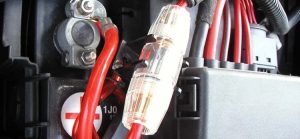
The battery-end fuse protects the power cable and belongs close to the source, with its rating matched to the actual conductor and installation. An internal amp fuse does not protect a long unfused battery cable. Have the installer resolve cable and fuse selection rather than copying the amplifier’s recommended fuse value onto an unsuitable wire.
Use a sound ground point, protected routing and secure mounting. Keep cables clear of seat travel and vehicle safety equipment; follow the vehicle’s power-disconnection procedure before installation. A bigger battery, capacitor or “Big Three” upgrade is not automatic proof that the charging system can sustain a high-power build.
Factory-radio compatibility: RCA inputs are only the last step
With an aftermarket receiver, compatible preamp outputs can make the signal path straightforward. With a factory system, first identify whether the signal is full-range, divided among channels, equalized, bass-reduced at higher volume or carried digitally. A converter can change signal level without correcting any of those other issues.
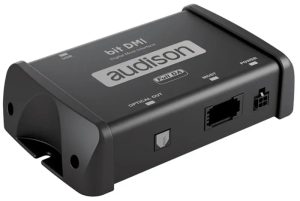
Do not connect a factory amplifier’s speaker output directly to an RCA input. A high-level connection also needs an approved signal range and suitable turn-on behavior. Some systems require a vehicle-specific interface, channel summing or DSP to retain chimes, navigation prompts and useful volume control. Resolve that before choosing the amp.
Gain, bass boost and filters: keep the setup disciplined
- Gain matches input level. It is not a power percentage or a second volume control. Use the applicable source and amp procedure with an appropriate test signal and clipping check; there is no correct universal knob position.
- Leave bass boost off initially. Adding boost consumes output headroom. Correct the source, enclosure and crossover problem before using boost to compensate for weak bass.
- Set crossovers for the drivers and enclosure. Door-speaker high-pass and subwoofer low-pass settings must work together. A ported enclosure’s protective high-pass/subsonic setting depends on its tuning, filter slope and driver requirements.
- Recheck the whole listening range. Verify turn-on, noise, normal playback and source changes. A clean voltage target from a multimeter alone does not prove the source or amplifier is free of clipping.
Common CT Sounds amp problems: what to check first
A fault symptom is not proof of a bad brand or a wiring mistake. Start with basic checks, then let an installer isolate the source, amp and load. Stop using the system if a cable or connection is overheating, a fuse repeatedly opens or there is a burning smell.
| Symptom | Check first | Avoid this response |
|---|---|---|
| No power | Correct battery supply, protective fuse, ground and remote turn-on, following the exact equipment instructions. | Bridging terminals or bypassing a fuse to force the amp on. |
| Protection mode on bass notes | Supply voltage at the amp under load, ground integrity, speaker shorts and final load. | Increasing gain or fitting a larger fuse without diagnosing the cause. |
| Shuts down after warming up | Airflow, mounting clearance, load, clipping and power delivery. | Assuming Class D means ventilation is unnecessary. |
| Weak bass | The actual impedance/rated output, source bass roll-off, filters, polarity and enclosure match. | Buying a larger amp before confirming that the present one receives a usable signal. |
| Whine or hiss | Grounding, input routing, interface compatibility and excessive gain. | Buying a noise filter before isolating the signal and power paths. |
| Distortion or harshness | Clipping at the source or amp, bass/EQ boost, driver limits and crossover setup. | Treating the gain control as a cure for insufficient power. |
| One speaker channel is silent | Channel settings and connections; use a controlled known-good signal/load check with the system powered down for rewiring. | Moving connections at random while the system is playing. |
If a fuse blows again, leave the system off until the short or overload has been found. If the correct supply, signal and supported load have been established and the fault remains, use the return or support route. Repeatedly restarting an amp in protection does not diagnose it.
CT Sounds vs Skar, Kicker and Rockford Fosgate
Compare exact models at the same load and system role. A CT mono amp is not a substitute for a four-channel DSP amp, and a lower stated wattage is not a disadvantage if it is the right output for the speakers. Brand-versus-brand claims about “cleaner bass” or “better build quality” are too broad to make this decision.
- Against another budget mono amp: compare RMS output at your final load, dimensions, controls, fuse/wiring needs and seller support. A larger peak-power number should carry no weight.
- Against a more expensive integration-focused amp: value the actual useful additions, such as a documented input range, signal processing or installation support. Those can reduce the cost and complexity of the complete job.
- For a demanding system: compare applicable continuous bench tests, cooling constraints and charging requirements. A higher output rating does not establish better long-term reliability.
- For a simple matched sub upgrade: paying for features the system does not need can be a worse use of the budget than improving the enclosure or installation.
Frequently asked questions
Are CT Sounds amps good for beginners?
They can be, when the project is defined before the amp is ordered. A matched mono amp, subwoofer and enclosure is easier to plan than a complex factory-system upgrade. Beginner-friendly controls do not remove the need to get wiring, load and gain right.
Can a CT Sounds mono amp power door speakers?
The CT-1000.1D and CT-1500.1D here are subwoofer amplifiers, not full-range door-speaker amps. Choose the CT-80.4D or a suitable speaker section of a five-channel model for that job. Multiple speaker terminals on a mono amp do not create independent stereo channels.
Is the CT-1500.1D better than the CT-1000.1D?
Only when the system can use its additional output. At a 2-ohm load the manufacturer ratings are 850W versus 650W; at 4 ohms they are 450W versus 350W. Decide using the subwoofer’s recommended power range and the complete installation cost, not the difference between the model numbers.
Will a CT Sounds amp work with a stock alternator?
That depends on the vehicle’s available charging capacity, the complete audio system and how hard it is used. No universal stock-alternator wattage limit covers every car. Assess voltage at the amplifier under load and have the electrical plan checked before committing to a high-output build.
Why does a CT Sounds amp get hot or enter protect mode?
Possible causes include restricted cooling, a load below the approved limit, voltage drop, shorts or sustained clipping. Warmth alone does not establish a fault; repeated shutdown needs diagnosis. Check the installation and load before assuming either the amp or the wiring is responsible.
Does CT Sounds have a warranty on Amazon?
Confirm coverage for the exact seller and condition before buying. The brand’s public FAQ expressly states one-year limited coverage for purchases through its own website; it does not establish identical terms for every Amazon seller. Keep your receipt and serial number and check the return window separately.
Should you buy a CT Sounds amp?
Yes, if the exact model fits the system and the total installation stays sensible. Start with the CT-1000.1D for a matched subwoofer, choose the CT-80.4D for speaker channels, and use the CT-800.5D when modest bass and one chassis suit the plan. The CT-1500.1D is the step up for a justified power need. Buy the right load, signal path and installation—not the biggest wattage on the page.